|
|
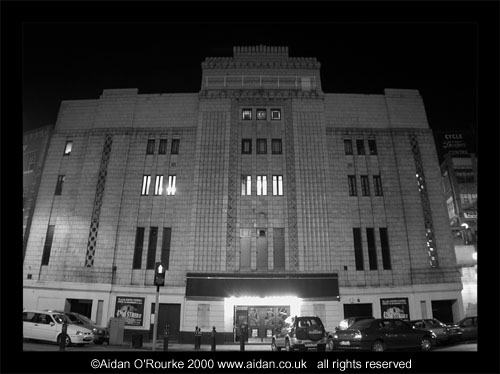
THE TILED FACADE OF THE PLAZA
SUPER-CINEMA became visible again in late 2000, when scaffolding was removed
after the completion of renovation work.
The job was completed in time
for an occasion when history repeated itself: On the 30th of November
2000, an enthusiastic audience saw the film "42nd Street" -
the same film shown on the opening of the cinema in 1932.
Here we see the cinema at approximately
10.30pm shortly after the programme finished.
|
|
|
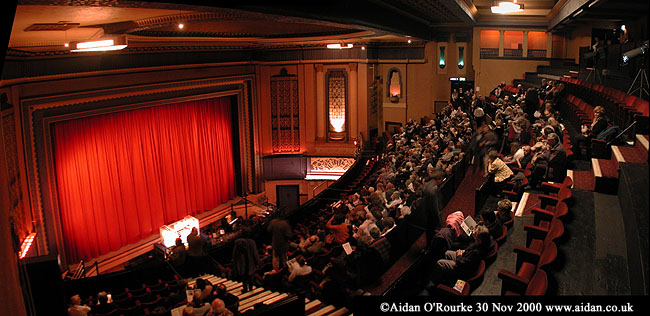
THE PLAZA SUPER CINEMA, Mersey
Square Stockport saw the historic return of a cinema audience on Thursday
30 November 2000, when the commemorative premiere of the film "42nd
Street" took place.
The supporting programme included
Al Jolson tribute artist Steve King, accompanied by the Plaza Orchestra,
and the organist Colin Hilton.
After many years as a bingo
hall, the Plaza was taken over by the Stockport Plaza Trust, who are running
the cinema as a cinema and performance venue, and are helping to restore
it to its original splendour.
|
|
|
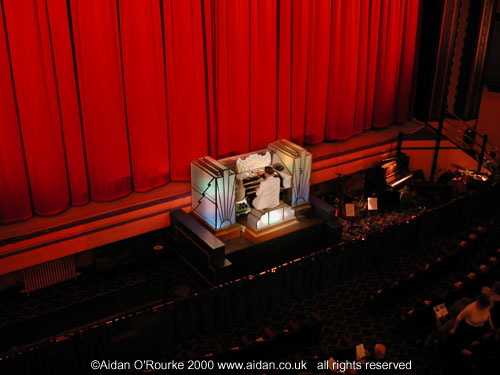
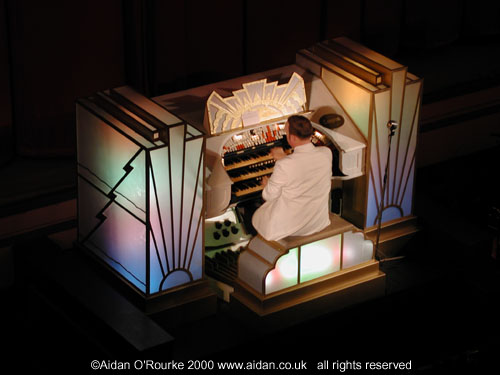
THE COMPTON CINEMA ORGAN is
one of the treasures of the Plaza Super Cinema, Stockport - it's one of
the few fully working cinema organs still operation in its original location
anywhere in the UK.
Here we see the organ being
played by renowned organist Colin Hilton, on the evening of the premiere
of 42nd Street, on 30 November 2000.
|
|
|
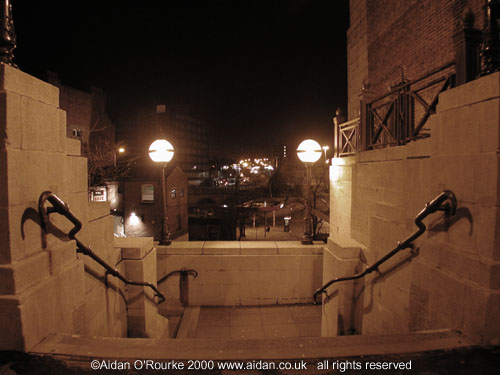
THE STEPS NEXT TO THE PLAZA
CINEMA, Mersey Square Stockport, were built in 1929, three years before
the completion of the cinema itself. In the year 2000, they still look
largely as they did when they were first built.
As a child I have strong memories
of climbing up and down these steps, which seemed much bigger then than
they do to me now. In the background we see part of Mersey Square, and
in the distance, Wellington Road North.
|
|
|
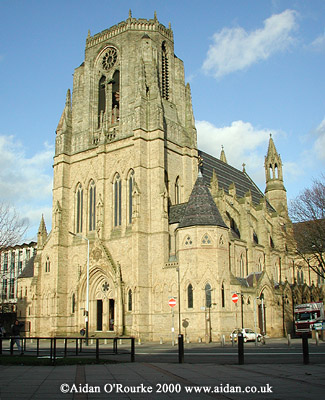
THE
CHURCH OF THE HOLY NAME OF JESUS, on Oxford Road, was opened in 1871, and
designed by Joseph Aloysius Hansom, famous for designing the two-wheeled
'hansom cab'. As can be seen from the difference in the colour of the stone,
the octagonal shaped tower was added much later - 65 years later, in 1928.
The style is 13th century gothic, similar to cathedrals in France. Every
day at six o'clock, the bells of the Holy Name are rung. It's a striking
piece of Victorian sacred architecture in a highly profane setting - diagonally
opposite the Manchester University students union building. |
|
|
THE WHITE CITY GATES originally
formed the grand entrance to the Botanical Gardens, opened in the late
19th century. A picture in the Central Library Local Studies collection
shows the gates as they looked just over 100 years ago, covered in ornamentation
which has since disappeared.
When the gardens closed, the
gates were incorporated into a greyhound track, and finally, a trading
estate..
Despite their uniqueness and
beauty, little is made of the White City Gates as a feature - the view
of the gates from the main road is now obscured by one of the mounds built
in between the slip roads of the Trafford Road roundabout. I was standing
on the mound when I took this photograph - only possible by using a wide
angle lens.
|
|
|
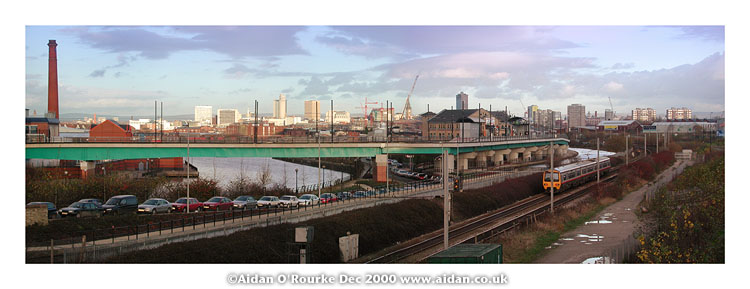
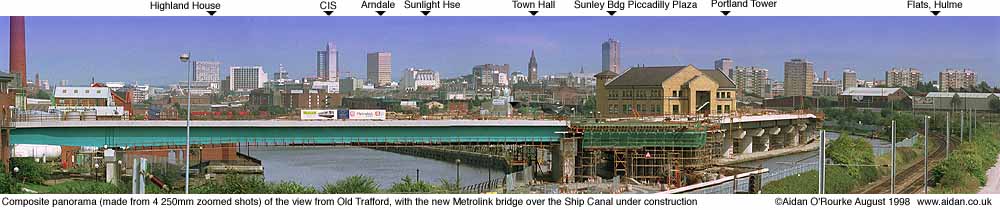
THE VIEW FROM OLD TRAFFORD
looking towards central Manchester gives quite a spectacular view of the
city centre skyline. It's difficult to imagine how this spot must have
looked 200 years ago, when this was open countryside, and the River Irwell
was used by sailing boats.
In 2000, several transport
routes run parallel to each other- the Ship Canal, now no longer used
by ships, the recently built Metrolink bridge, used by trams on their
way to and from Eccles, the Bridgewater Canal, which runs through Trafford
Park, the Manchester to Flixton and Warrington Railway line, and out of
the picture to the right, the new road from Old Trafford towards the city
centre.
|
|
|
THE
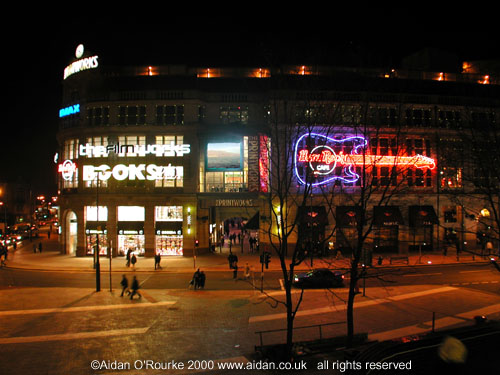
PRINTWORKS, opened in late Autumn 2000, is Manchester's most exciting
new entertainment and leisure complex.
It's housed in the former Kemsley
House, once home to the Daily Mirror and the Evening Chronicle.
The exterior has some eye-catching
light features, including the giant neon guitar of the Hard Rock Cafe,
and above the main entrance, a very bright video screen showing blue skies
and seas.
Interesting to note that on
either side of the main entrance, there are the two lanterns which originally
adorned the hotel which stood on this spot before Kemsley House was constructed.
|
|
|
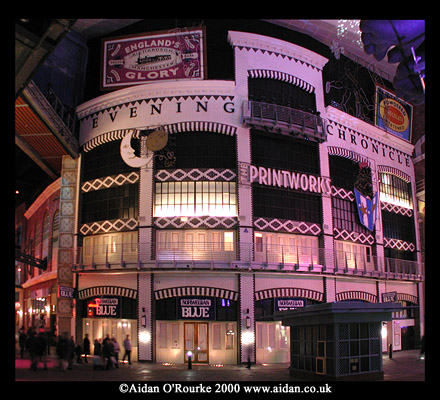
THE INTERIOR OF THE PRINTWORKS
is a celebration of Manchester's past, present and future, highlighting
the role played by newspapers in the life of the city. Famous titles of
the past, including the Evening Chronicle and the Daily Sketch, can be
seen on the facades, which are recreations of the past.
But the Printworks also looks
into the future, with an amazing light and video show which is projected
onto the only ceiling screen I've ever seen. There's also the Film Works
cinema complex, with its state of the art projection systems.
It's loud, exciting, entertaining,
and futuristic in its appeal, but it's also educational in the way it
recreates a sense of the old Manchester.
Eyewitness says: The Printworks
is the best thing to happen to city centre Manchester in a long time and
I have only one criticism: It's not big enough.
|
|
|
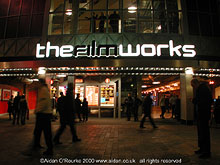
THE FILMWORKS, part of the
UCI Cinema chain, offers Manchester audiences the cinema technology of
tomorrow. As well as multiplex screens, some of them using digital projection,
there is a giant Imax theatre showing films made in the super-size Imax
format.
The screen is several storeys
high, and fills your field of view right out to your peripheral vision.
It makes for a visually breathtaking experience, especially when the film
is in stereo vision.
|
|
|
THE PRINTWORKS main entrance
was once used by horses and carts carrying newspapers out of the works
and on to newspaper stalls and newsagents.
Now that the former Kemsley
House has been transformed into the fabulous Printworks development, people
can walk inside and enter a world of showbiz razzamataz, neon signs, sound
and lighting effects, as well as building facades recreating of the Manchester
of old - a kind of giant 'Lark Hill Place' (the museum street at Salford
Museum and Art Gallery)
Through the arched entrance
can be seen the bright lights of the Marks and Spencer building, on the
other side of Exchange Square.
|
|
|
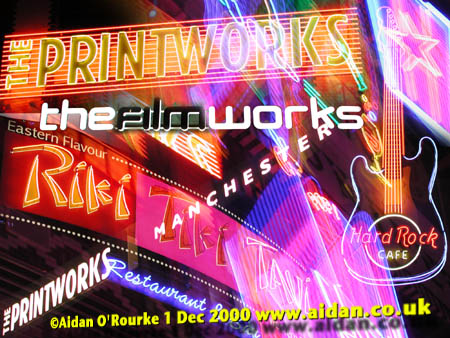
THE PRINTWORKS NEON LIGHTS
add an aura of transatlantic glitz to the interior of this superb new
entertainment centre.
In this picture we see some
of the famous names which have already taken up residence in the Printworks:
The Hard Rock Cafe, the restaurant Riki Tiki Tavi and the Film Works cinema
complex.
In early 2001, more bars and
restaurants will be opening up, adding a further buzz of excitement to
this already fun-filled place.
Eyewitness says: In the
Printworks, Manchester has gained a fantastic new attraction which brings
people a glimpse of the future, whilst recreating the best of the past.
|