|
|
WE START WITH A LOOK INTO THE FUTURE and a vision of how things might have been... |
|
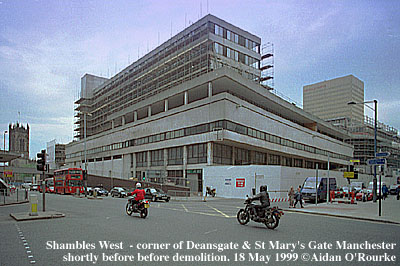
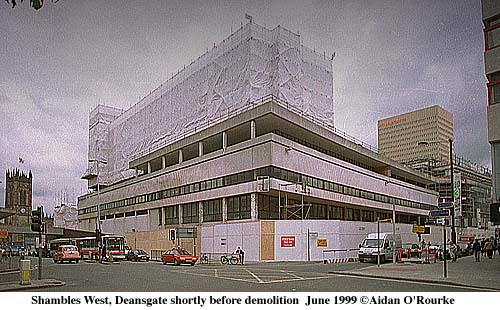
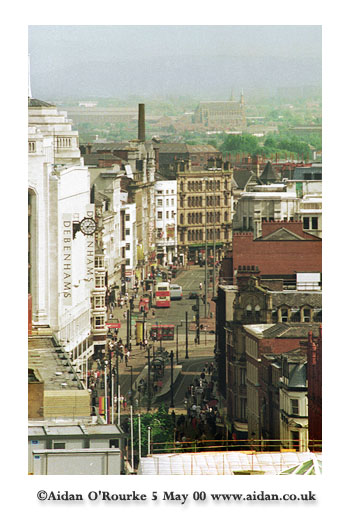
NUMBER ONE DEANSGATE is a prestige development of apartments and offices standing on the corner of Deansgate and St Mary's Gate. The upper picture is a visualisation by Ian Simpson Architects, designers of the building, of how it will look when completed. The giant glass and steel structure with its currently fashionable wedge-shaped roof sits on top of a set of triangular strut-like supports. Soon some high-flying resident will take possession of the keys to Manchester's first two million pound apartment which will occupy the top floors of the building. Previously this site was occupied by the dreadful Shambles West development - an extension of the Arndale Centre into which the the Shambles, the oldest surviving building in the centre of Manchester, was slotted in. From my earliest childhood memories I remember this area in the early 1960's as an empty triangle of grass, the site of the Victoria Buildings, sadly demolished after firebomb damage during the Manchester Blitz of 1940. Eyewitness says: This is a bold and audacious design - to me it looks precarious, I'm sure it isn't - but is this an appropriate setting, close to Manchester Cathedral and the Royal Exchange? How will people respond to such a bold and high tech addition to this part of the city centre? Residents on the Deansgate side of the building will have a view not over Salford but into the rooms of the Ramada Renaissance Hotel. Those on the south side will have spectacular view of the city centre and areas to the south east. The lower picture shows the present view from the top floor of the Ramada Renaissance Hotel along Market St, Piccadilly and to the south east. |
|||||
|
THE VICTORIA BUILDINGS stood on the triangle bounded by St Mary's Gate, Deansgate and Victoria Street. In 1940 they were damaged by firebombs during the Manchester Blitz and subsequently demolished. The Victorian shopping arcade and office building had a magnificent three-sided façade with three curved corners. Inside there was an open area with a domed glass roof. There were shops, offices and at the Manchester Cathedral end, a hotel. It was a ground-breaking example of a multi-purpose city centre development, and opened in 1880. 85 years later, Piccadilly Plaza tried, and failed to achieve the same thing. Most people today are unaware the Victoria Buildings ever existed, such is the widespread ignorance of the city's character in times other than our own. If the Victoria Buildings had survived, they would be a major attraction: a magnificent Victorian shopping mall, bigger than the Barton Arcade, older and more impressive than the Corn Exchange and by now completely renovated. Eyewitness says: It is very unfashionable to say so, but the Victoria Buildings could have been rebuilt, Victoria Street reinstated and the Shambles kept in their original site. In Berlin and other parts of Germany, museums, churches and other historic buildings have been and are being restored. It costs a fortune and takes years to achieve, but the results will last for centuries and draw millions of visitors. UK attitudes dictate that such reconstruction should always be rejected. I wonder which buildings tourists would prefer to visit, the ultra-modern No1 Deansgate and Shambles Retail Development with their glass and steel 'more airport than an airport' exterior - or a reconstructed stone-built Victorian shopping arcade that looks so new it seems as if it has jumped in time from 1880 to the year 2001? |
|||||
 |
THE SHAMBLES retail development will stand next to Number One Deansgate, facing onto New Cathedral Street. This is the visualisation of the project, as photographed during March 2001. It gives us a good idea of how the building will look. The facade of the building is concave, following the gentle turn of New Cathedral Street. With its use of curved glass, brickwork and steel, and its sober, serious high-tech character, within the context of the new city centre, it's a case of 'more of the same'. |
|||||
|
|
THE LOWRY HOTEL is Manchester's first five star hotel. It occupies a formerly forgotten and run-down site on the Salford side of the River Irwell, next to the Calatrava or Trinity Bridge with which it now forms an interesting double act. The hotel opened in March 2001, and it promises to be a popular city centre for the rich and maybe the famous. The most expensive rooms are, I understand, luxuriously fitted out and service is top notch. Eyewitness says: The building is unique in Manchester, in that its main facade, an all-glass curtain wall facing onto the river, bends round, echoing the geometrically elegant curves of the footbridge. Perhaps it juts out above the Irwell a little too much, obscuring the view of the cathedral, but there's no doubt that this finely crafted hotel and bridge next to it have transformed this area from a shabby backwater into a prime riverside location. |
|||||
|
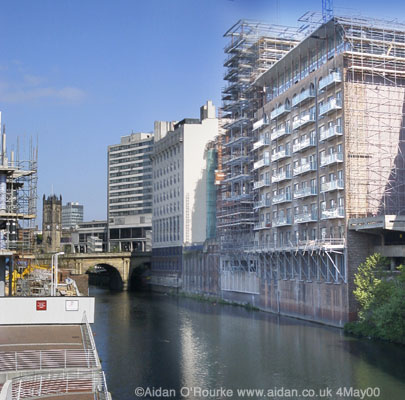
THE NEWLY RENOVATED CENTURY BUILDINGS look out across the River Irwell towards Salford, just across from the Lowry Hotel. Two buildings, incidentally both constructed 60 years apart by the same architectural practice (that of Harry S Fairhurst) , have been converted from office buildings into apartments. New balconies have been added to both the old building, dating from 1905 and its next door neighbour, completed in the 1960's. Extra floors have been added to both, with high level penthouse apartments at the very top costing around one million pounds. Who in their right minds would have thought, a few years ago, that people would be prepared to pay a million pounds for an apartment whose rear window faced out onto the River Irwell - such is the amazing transformation of Manchester city centre. In May 2001, a two bedroomed apartment on the 8th floor of Century Buildings and a five bedroomed semi-detached house in the highly desirable suburban district of Hale cost the same amount - £300,000. The lower picture shows the development during the construction work. The Lowry Hotel can be seen on the left. |
|||||
|
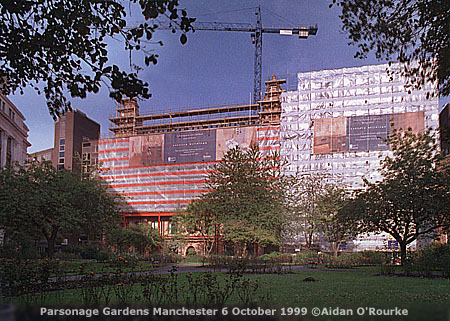
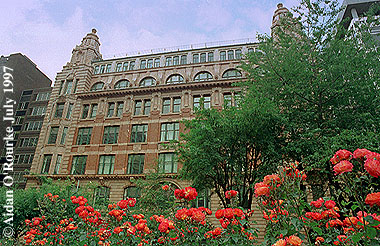
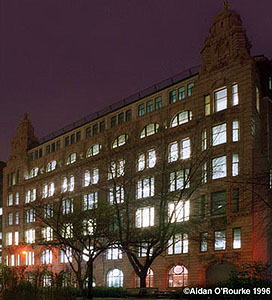
THE NEWLY RENOVATED CENTURY BUILDINGS overlook Parsonage Gardens at the front. The name Parsonage Gardens originates in the fact that St Mary's Church used to stand here, so this is consecrated ground, and cannot be built on. Century Buildings is one of the most prestigious of city centre developments, and the architects have gone to great lengths to retain and enhance the character of the older building. The newer one, which had a glass and brushed steel facade, has now been fitted with newly designed smoked glass windows, exterior wood, and extra floors have been added at the top. The lower pictures show the building during and before conversion. Personal note: The lower right picture in December 1996 whilst waiting for Ann to emerge from the building - she worked there as a temp secretary. |
|
|
THE URBIS CENTRE promises to be one of Manchester's most interesting, exciting and informative attractions. Exhibits on the theme of 'the city' will be housed in a futuristic glass-walled building which rises up like a ship towards the junction of Withy Grove and Corporation Street. This most modern of buildings is situated in one of the oldest parts of Manchester. Let's also not forget that on part of the site stood the Lancaster Arcade, demolished in the 1960's and, one of the many pieces of 'lost Manchester' which most people today have forgotten or are totally unaware of. Putting a brash piece of glass-walled modern architecture right in heart of what was once the medieval town centre, next to the cathedral, Chetham's School, the Corn Exchange is fully in keeping with current planning policies in Manchester. With so much of the original city lots to wartime bomb damage and post war redevelopment, juxtaposing new and old is perhaps the only way of creating something new and viable out of the decay and dereliction which has characaterised many parts of the city centre in post-war years. |
||
 |
THE PRINTWORKS entertainment complex is a conversion of the former printing works on Withy Grove. There is a multiplex cinema with Imax screen, restaurants, including the Hard Rock Cafe, and shops, including Books etc. In the bottom of the picture I've caught some of the infamous tiles of the Arndale Centre, here on the walkway leading up to the John Willie Lees pub. Very soon this side of the Arndale Centre will be transformed, adding another piece, as they say at Manchester City Council, to the new city centre jigsaw. Eyewitness says: The Printworks is a fabulous development, as it combines future media technology with a recreation of Manchester's newspaper heritage. |
|
Intropage | Page 1 | Page 2 | Page 3 | Page 4 | Page 5 | EWM home page |