|
 |
|
HERITAGE OPEN DAYS
are held every year to enable people to see buildings which
are normally closed to the public. Over eighty sites all over
Greater Manchester opened their doors on Saturday and Sunday
the 16th and 17th of September 2000. I'd love to have visited
all of them, but time is limited and you need an hour or two
for each one.
Again and again
we see how our local heritage, which in the sixties and seventies
was under-appreciated and often left to rot, is at the turn
of the millennium being reborn and celebrated for present
and future generations.
One of the places
undergoing a rebirth is Ancoats, and it's there that I was
introduced to a very distinguished visitor...
|
|
|
THE LORD MAYOR OF MANCHESTER, Councillor Hugh Barrett, visited
Ancoats on the occasion of the Heritage Open Days on Saturday
16 September 2000.
He was invited by Ancoats Buildings Preservation Trust. Eyewitness
in Manchester had the honour of interviewing and photographing
him. Here he is standing just outside Murrays Mill, on Murray
Street.
The Lord Mayor has many childhood associations with Ancoats,
though his parental home was in nearby Ardwick. He began his
career as a councillor when elected for the Ardwick ward on
23 October 1968. He represented Ardwick until 1994, when he
was elected Councillor for Sharston, in Wythenshawe.
Councillor Barrett manages to combine friendliness and a
sense of humour with the dignity of his high office. In his
talk to the members of Ancoats BPT, he remembered his childhood
days, spent of the district, but also spoke out on the future
of Ancoats: City centre apartments, he says, should be built
for families, not just singles and couples.
He has been Lord Mayor since 17 May 2000, and will remain
in office until May 2001.
|
|
|
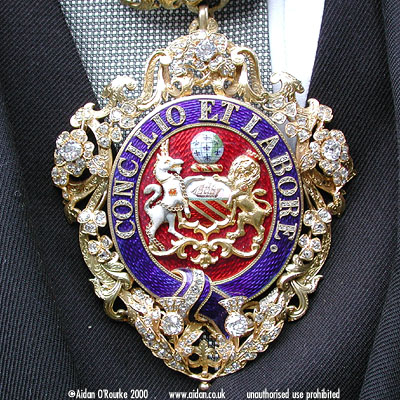
THE COAT OF ARMS of the City of Manchester is seen here inscribed
on the medallion worn by the Lord Mayor on official occasions
and visits.
This particular medallion was made in 1855, and was presented
on the visit of Queen Victoria. An inscription on the reverse
bears witness to this fact. There are 169 jewels and it's
made of 18 carat gold. Surrounding the central oval are the
English rose, the Irish shamrock and at the bottom, the Scottish
thistle. The Welsh leek is also visible.
Inscribed on the belt, symbol of security, are the words
"Concilio et labore", which the Lord Mayor translated for
me as "Consider the action before you work at it", motto of
the City of Manchester, still highly relevant today and not
always observed by decision-makers in the Town Hall.
The coat of arms shows a globe, symbolising Manchester's
trade throughout the world, bees, signifying industry, and
a ship, which reminds us that Manchester was a port even before
the 1894 Ship Canal. The unicorn and lion are traditional
heraldic symbols.
Any more comments or information, please contact.
|
|
|
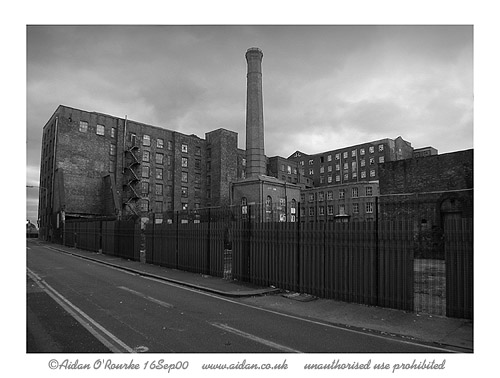
MURRAY'S MILLS, Ancoats can, according to local historian
Steve Little, probably claim to be the oldest urban all-steam
cotton mill in the world. Murray's first mill was built in
1798, and was subsequently added to, forming the complex of
mill buildings we see here.
The decline of the British textile industry began around
the 1930's and continued in the post war years. Cotton spinning
ceased here in 1959.
In the 70's, planners might have happily razed the mills
of Ancoats to the ground and put up modern blocks in their
place, but in recent years their priceless historical value
has been recognised. They were listed Grade II* in 1989, which
means they're designated as being architecturally significant
and can't be pulled down.
The buildings may look solid on the outside, but they need
millions of pounds worth of renovation both outside and inside.
Fortunately over £5m of Lottery money has been secured by
Ancoats Buildings Preservation Trust for the rescue of buildings
in Ancoats, including these ones.
In a few years if all goes to plan, they will house apartments
and commercial properties - maybe I'll be living and working
in one of them!
For more information about Ancoats Buildings Preservation
Trust, visit their website at www.beehivemill.freeserve.co.uk
|
|
|
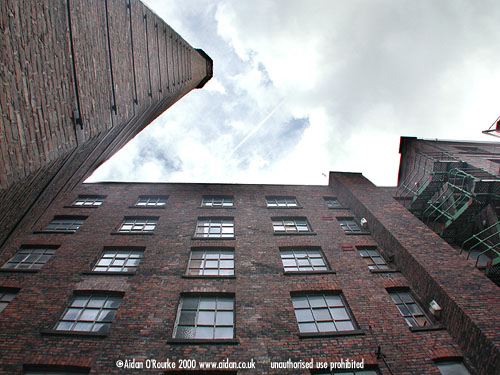
MURRAY MILL is seen here looking up from the courtyard towards
the sky. Everything we can see in this picture is original
(apart from the burglar alarms). Metal bands securing the
chimney also have steel bars to enable a steeplejack to climb
up.
The iron fire escapes on the right are also characteristic
of industrial buildings I've seen in New York.
What must it have been like for a nineteenth century mill
worker to look up at the sky and see only grey clouds and
smoke?
|
|
|
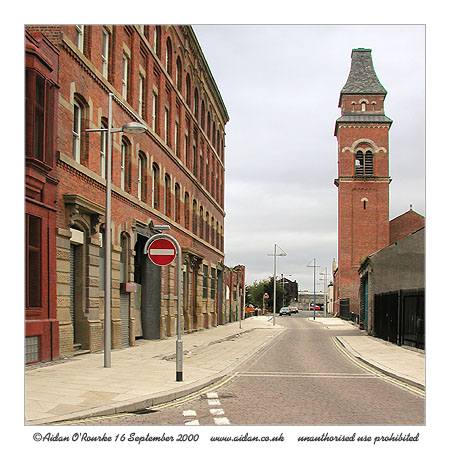
THIS IS BLOSSOM STREET, Ancoats, as seen on 16 Sep 2000.
The restored facade on the left has recently been unveiled.
St Peters Church, with its renovated exterior and tower roof
is further along the street on the right.
The mid-Victorian character of the scene is however spoilt
by contemporary additions. The street lights, showing the
current fad for redundant design features - here an unnecessary
diagonal support - are typical of a style which I've seen
all over Europe. The 'wrap around' no entry sign makes an
already intrusive piece of street furniture even more intrusive.
In the 1950's, someone in the UK's Ministry of Transport
came up with the idea of single and double yellow lines. Most
other countries seem to be able to regulate parking without
these road markings, which spoil many a Lake District or Cotswolds
village.
Here they are embedded in specially made setts, though the
lines are narrower than normal.
Eyewitness says: Restore the setts, flagstones and lampposts
'film-set-style' as closely as possible to their original
state, using old photographs.
|
|
|
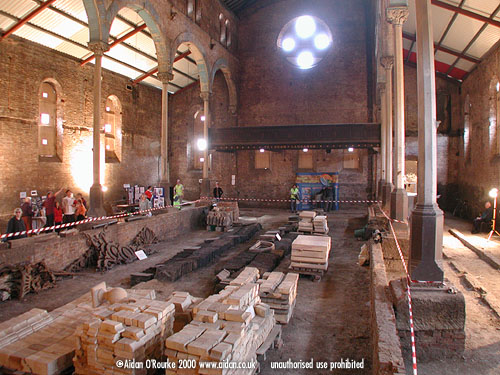
ST PETERS CHURCH was built in the 1860's to serve the densely-populated
industrial district of Ancoats. It survived for over a century
but closed in the 1970's and was subsequently used for storage.
Its condition deteriorated over time and it suffered vandalism
and a fire in the tower.
In 1996 was identified as 'a key historic building at risk
of loss'. Ancoats Buildings Preservation Trust secured funding
and the exterior was renovated.
The interior remains an empty shell. Here we see it open
to the public on Saturday 16 September during the Heritage
Open Days.
In future, the building may become a centre for the arts
or some other public use, or it may even be used as a church
again.
|
|
|
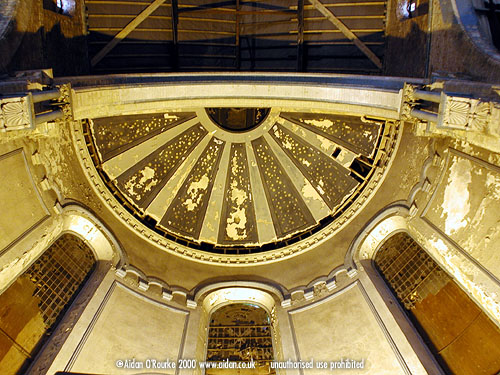
WE ARE INSIDE ST PETERS CHURCH, Ancoats, looking up at the
roof of the apse.
Much of the paintwork is peeling off, and many window panes
are missing, but the essentials the church interior are still
there.
At the top of the picture we can see the temporary wooden
roof. The curved plaster ceiling will be reinstalled as closely
as possible to the original.
What a shame this remarkable church was allowed to fall into
decay in the first place.
Thank goodness - thank Ancoats BPT! - it has been saved and
will be used again by future generations.
For more information about Ancoats Buildings Preservation
Trust, visit their website at www.beehivemill.freeserve.co.uk
|
|
|
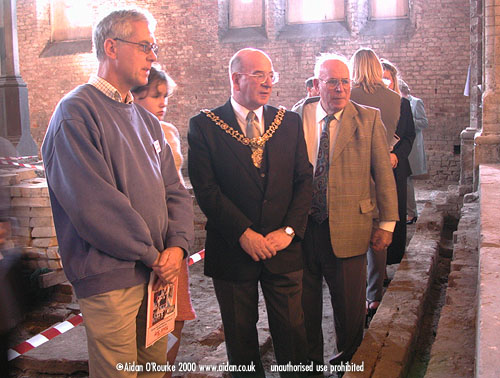
THE LORD MAYOR OF MANCHESTER, Councillor Hugh Barrett, visits
St Peters Church, Ancoats on the occasion of the Heritage
Open Days, 16 September 2000.
He is looking at a slide show of old and new pictures of
Ancoats, part of a visitors display set up by the Ancoats
Buildings Preservation Trust.
|
|
|