AIDAN O’ROURKE

Tutor & Digital Journalist   AidanEyewitness  AidanTutor

Please subscribe to my AidanEyewitness YouTube channel
  • Home page
  • Photo walks & tuition
    • Liverpool Photo Walk
    • Manchester Photo Walk
  • Online language classes
  • Articles / blog posts

My review of the Liverpool Albert Dock and Three Graces Walking Tour

2017-08-26 By Aidan O'Rourke

If you’re visiting a city and want to get the inside story on its history and attractions, who should you go to? A tour guide of course.

I know Liverpool well but I’m always interested in finding out more. That’s the reason why I went on a tour of The Albert Dock and the Three Graces. I wasn’t disappointed. I discovered many new facts.

For instance, I didn’t know that the Albert Dock is the largest complex of Grade 1 listed buildings in the UK, that it was a state-of-the-art building when first built in 1846. I knew already from a tour with historian Quentin Hughes that it was nearly demolished. That was in the 1970s when the Albert Dock was in a derelict state, the basins were silted up and the entire district was closed off. The proposal was to demolish the buildings, fill in the docks and replace them with a car park. Thankfully the Albert Dock was restored and is now Liverpool’s top tourist attraction. It is a unique place – inside the solid brick warehouses house restaurants, apartments, shops, the Tate Liverpool, the Beatles Experience and the Liverpool Maritime Museum, incorporating the Museum of Slavery. The Albert Dock is a must-see for all visitors to Liverpool and a regular haunt for those of us who live in or not far from the city.

There are many reminders of its past – the Dock Traffic Office with its Roman style portico – actually the pillars are hollow and made of cast iron. It was used as a studio for Granada Television. Round the corner there’s a curious ‘helter-skelter’ chute on the exterior of the building. I’d never even noticed it before. It was used to carry ice cubes from the upper floors to a cart where they would be transported to the homes of Liverpool’s wealthy families. The Pump House – now a restaurant – contained the hydraulic pumps used to open and close the lock gates. The Piermaster’s House has been furnished in the style of World War II, when Liverpool was a major target for bombing. You can imagine the Piermaster and his family listening to the wireless and then hearing the air raid siren echoing over the docks.

A few minutes walk away and we come to the three magnificent buildings which are the most famous symbol of Liverpool, often referred to as the ‘Three Graces’. They were built on the site of St George’s Dock. Around the turn of the 20th century it was filled in and two streets were extended across it – Brunswick Street and Water Street. dividing it into three rectangles. On each of these three sites, three buildings appeared: The Port of Liverpool building, the Liver Building and the Cunard Building, completed in 1907, 1911 and 1916, respectively.

The Port of Liverpool Building was designed by Sir Arnold Thornley and F.B. Hobbs and is magnificent inside and out. It was the headquarters of the Mersey Docks and Harbour Board until 1994. Today the building is used by private companies. I was surprised to discover it is only Grade II* listed. It has many superb architectural features. The dome is similar to St Paul’s Cathedral and Belfast City Hall. Many people are not aware that it’s possible to go inside the lobby and admire the magnificent view up towards the inside of the dome. It is a building with ‘wow’ factor. The exterior made of Portland Stone.

It’s important to note that up until the 1960s the exteriors of all three buildings were blackened by air pollution. I will never forget visiting Liverpool in the late 1960s just after they were cleaned. The Port of Liverpool Building seemed to me like a gigantic wedding cake made of pure white icing sugar. Today, in bright, clear sunlight, the exterior for me has a ‘singing ringing’ effect. There are many parallels between architecture and music, but that’s another story!

Next door to it is the Cunard Building, which is also Grade II* Listed. This was once the terminal for wealthy passengers boarding transatlantic liners. They would complete their paperwork in the grand hall and make their way to the front lobby to await embarkation. Our tour guide painted a vivid picture of the hall, with its elegant interior and perhaps a string quartet playing tasteful music. Today that area is the British Music Experience, a permanent exhibition dedicated to the history of popular British Music. It’s not possible to go to the upper floors of the Cunard Building. This is a working office building, and surely one of the best addresses in Liverpool. The building was designed by William Edward Willink and Philip Coldwell Thicknesse, and was inspired by the Farnese Place in Rome. It was the headquarters of the Cunard Line until the late 1960s. Since 2015 it is owned by Liverpool City Council. The office of the Mayor of Liverpool Joe Anderson, is in the Cunard Building. One interesting fact: It is slightly wider at the rear and so has the shape of an uneven rectangle. Like the Port of Liverpool building it is faced in Portland Stone.

The Liver Building is the most famous building in Liverpool. It is made of granite and so the exterior colour is rather dull. But due to its unique design and the two clock towers at either end, topped with the world famous Liver birds, it has become a powerful symbol of Liverpool. Local people are very proud of the building, which can be seen from many vantage points in the city and across the Mersey. It is a building of superlatives. It was Europe’s first skyscraper. It was the tallest building in Europe from 1911 to 1932. The clock faces are bigger than those on the Elizabeth Tower of the Houses of Parliament – more commonly known as Big Ben. The Liver Building is inspired by architecture of the USA, reflecting Liverpool’s rich transatlantic connections. It was designed by Walter Aubrey Thomas and is rightly Grade I listed. Two mythical Liver Birds at the top of the building soon became the symbol of Liverpool. They were designed by the German woodcarver Carl Bernard Bartels.

Originally from Stuttgart Carl Bernard Bartels settled in England and became a naturalised British citizen. He won the commission to design the mythical birds which were completed in 1911. Despite having British citizenship he was interned on the Isle of Man during the First World War and was deported in 1918, leaving his wife behind. He returned and spent the rest of his life in the UK.

The interior of Liverpool’s most famous building may surprise many visitors. Unlike the other two buildings, the Liver building has an interior space. After renovations, the lobby is contemporary in style, with some original features visible, including a plaque dedicated to Carl Bernard Bartels. Looking up through the glass roof of the lobby into the inside space, you will see that the interior walls have been covered with a modern style glass cladding. It’s invisible from the outside of course, but in my opinion, it spoils the character of the building. In my opinion the building should at some time in the future be restored to its original state.

And after we emerged from the side entrance of the Liver building, our tour came to an end. Our Blue Badge guide Tony Boner really entertained and informed us with his deep local knowledge and Liverpudlian sense of humour.

My advice to anyone, anywhere: Even if you’re a local, book a guided tour with a knowledgeable guide. You’ll learn many new things!

The Liver Buidling, Cunard and Port of Liverpool Blgs reflections
The Liver Building, the Cunard Building and the Port of Liverpool Building reflected in the Albert Dock (Image turned upside down and flipped horizontally)
Albert Dock and Canning Dock
Albert Dock Liverpool, looking across Canning Dock towards the Dock Traffic Office and the Pump House
Panorama of the Albert Dock
Panorama of the Albert Dock with the Liver Building, Cunard Building and Port of Liverpool building on the far left.
View of the Three Graces from the Albert Dock 2002
View of the Three Graces before the construction of the Mann Island building (15 April 2002)
View from the Albert Dock of the Three Graces
View along the Albert Dock towards the Three Graces. The new building constructed on Mann juts in on the right, obscuring the view of the Port of Liverpool Building
LIverpool Albert Dock and moored boats
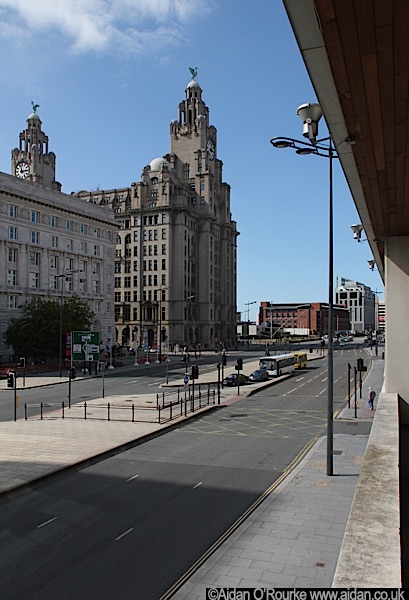
Cunard and Liver Buildings seen across The Strand
View of the Port of Liverpool building from Canning St next to the Anglican Cathedral
View of the Port of Liverpool building from Canning St next to the Anglican Cathedral. On the right is the Queensway Tunnel ventilation building
Liverpool Pier Head, Three Graces and canal
Liverpool Pier Head, Three Graces and canal.
The Liver Building, Cunard Building and Cunard Liner Caronia
The Pier Head, Port of Liverpool Building and tourist signs
The Liver Building and Liver Bird 2002
The Liver Building and St Nicholas Church in afternoon sunshine
The Liver Building in sunshine
Memorial stone to Carl Bernard Bartels, Sculptor and Designer of the Liver Birds 1866-1955
Memorial stone inside the Liver Buidling lobby – Carl Bernard Bartels, Sculptor and Designer of the Liver Birds 1866-1955

Filed Under: AidanEyewitness YouTube channel Tagged With: Albert Dock, Architecture Liverpool, Liverpool, Liverpool waterfront, Pier Head, Three Graces

Featured book: Liverpool Then and Now

2016-06-13 By Aidan O'Rourke

BookCoverLivThenAndNow-1200px

The changing face of the city has been a dominant theme in my photography since the early days. It was fitting therefore that I was commissioned by Anova books in 2011 to take the ‘now’ photos for the book Liverpool Then and Now.

I was presented with a list of ‘then’ photographs drawn from various sources including the Liverpool Records Office and Anova’s own collection of heritage images. My task was to find the locations and take the ‘now’ photo from as close as possible to the viewpoint of the old photo.

Soon I had embarked on a fascinating journey of discovery through the Liverpool area as far as Southport in the north to Speke in the south.

I also crossed over the River Mersey to visit locations on the Wirral, and in the first half of September I took photographs from Seacombe ferry terminal of visiting cruise liners docked by the Pier Head. One of these images appears in the opening pages of the book.

Liverpool Pier Head and Mersey Ferry

Locations featured in Liverpool Then and Now include: the Royal Liver Building, the Albert Dock, Lord Street, Lime Street station, the Anglican Cathedral, Bold Street, The Strand and many more.

I also discovered many lesser known places including the former observatory on the Wirral, now a private residence, the Liverpool Institute, now LIPA, the Florence Institute in Toxteth, and the exact point where the East Lancs Road begins. The old photo depicts the opening ceremony. It took me a while to discover where it had been taken but eventually I found it.

Some of the places depicted in the old photographs were impossible to locate and had to be omitted.

And I can reveal one location is wrong! The fountain I photographed in Sefton Park is not the one in the old photo.

About three months after publication I was walking in Sefton Park and discovered that the fountain I should have photographed is the one next to the Peter Pan statue in the middle of the park. No one has noticed so far!

One of my favourite views was from Everton Brow I did the panorama and the editors decided to include it even though that old photo wasn’t a panorama.

View from Everton Brow

In many places I found the people I met to be very warm and friendly, for example the man who lives near the ‘Florrie’ or Florence Institute who saw me taking a photograph, came out to tell me all about it, and gave me some leaflets.

The staff at the Town Hall were also very welcoming and helpful, and I was given a guided tour around the Liver Building and the former Speke Airport terminal, now a hotel.

Photographing Liverpool Then and Now was a great experience and I really got to know Liverpool very well indeed.

I was very proud when in mid-2012 I found the book, ‘my’ book, on the shelf in the bookshop at Lady Lever Art Gallery. I have also seen it on sale at the Walker Art Gallery, Waterstones, in the Albert Dock and at the Museum of Liverpool.

If you’d like to buy a copy of Liverpool Then and Now from Amazon.co.uk, please follow the link to the right. If you’d like a signed copy for yourself or as a gift please get in touch.

Part way through the project, local author and historian Mike Royden was commissioned to write the text. His descriptions are very interesting, and demonstrate his deep knowledge of the city. The team at Anova Books in London – editors Frank Hopkinson and David Salmo – did a great job. The layout is excellent and the quality of reproduction of the photographs is very good indeed.

I am very proud to have helped to create this visually fascinating book on what is arguably the UK’s most visually fascinating city.

Filed Under: AidanEyewitness YouTube channel Tagged With: Dockers Umbrella, historical photos, Liverpool, Liverpool Records Office, now and then, old and new, Pier Head, then and now

CONTACT

E-mail: info@aidan.co.uk

or you can contact me by sending a message, text or WhatsApp to this number.

phone number spam protected

SELECTED ARTICLES & VIDEOS

Karen McBride “Just A Girl From North Manchester” book review

Video: Manchester Building Boom 2024 seen from train tram & drone

Classic 1963 split-screen VW camper van

Article: Our VW Split Screen Camper Van Nightmare

Video: Building Boom in Manchester 2021

AidanEyewitness video: Building Boom in Manchester 2021

Copyright © 2026 · News Pro Theme On Genesis Framework · WordPress · Log in

On some pages, this website uses cookies. You can opt-out if you wish.Accept Read More
Privacy & Cookies Policy

Privacy Overview

This website uses cookies to improve your experience while you navigate through the website. Out of these, the cookies that are categorized as necessary are stored on your browser as they are essential for the working of basic functionalities of the website. We also use third-party cookies that help us analyze and understand how you use this website. These cookies will be stored in your browser only with your consent. You also have the option to opt-out of these cookies. But opting out of some of these cookies may affect your browsing experience.
Necessary
Always Enabled
Necessary cookies are absolutely essential for the website to function properly. This category only includes cookies that ensures basic functionalities and security features of the website. These cookies do not store any personal information.
Non-necessary
Any cookies that may not be particularly necessary for the website to function and is used specifically to collect user personal data via analytics, ads, other embedded contents are termed as non-necessary cookies. It is mandatory to procure user consent prior to running these cookies on your website.
SAVE & ACCEPT