AIDAN O’ROURKE

Tutor & Digital Journalist   AidanEyewitness  AidanTutor

Please subscribe to my AidanEyewitness YouTube channel
  • Home page
  • Photo walks & tuition
    • Liverpool Photo Walk
    • Manchester Photo Walk
  • Online language classes
  • Articles / blog posts

AidanEyewitness video: Building Boom in Manchester 2021

2021-08-01 By Aidan O'Rourke

This video, Building Boom in Manchester 2021 follows on from my 2020 video on the same subject.

This time, I take a bike tour around the east, north and west side of the city centre, exploring and discovering the new developments which are under construction there.

I haven’t covered every development, but I’ve featured the ones which seem to me to be the most striking and sometimes controversial.

We start on Great Ancoats Street, the street which is probably seen more changes than any other and has been transformed from a rather down at heel part of Manchester to one where there is new construction going on everywhere, completely changing the character of the area.

We visit the New Islington district with an interesting assortment of apartment buildings constructed next to newly created stretches of canal and a newly built man-made lake in the middle of the city.

We stop off at the sad remains of Grade II Ancoats Dispensary which I featured in the previous video and there is news.

The building will be turned into affordable apartments, which ironically may not be affordable enough for local residents. Construction is set to go ahead sometime in the near future.

I feature the Smiths Arms pub in Ancoats which sadly was demolished, despite a high profile campaign to save it. I feel it could have been retained and would have added something valuable to the square, with all its restaurants and bars.

In Liverpool Ma Egerton’s pub was retained, despite the construction of a very large new student residence behind it.

In Angel Meadow, once a very rundown area, two new apartment buildings are under construction. Then we visit Four Angel Square, part of the corporative NOMA district of the city centre. We take a quick look at the Ducie Bridge pub which despite a campaign, was demolished to make way for this new development.

Next to Victoria Station, a major new development is under construction on what seems like a very small section of land. On the other side of Victoria, we find the construction site of the new Manchester College campus.

Continuing along Trinity Way, construction of a tall building is currently paused, due to allegations of fraud. Find out more in the video.

We continue past Collier Street Baths, still standing derelict behind scaffolding. We cycle past a new development on Chapel Street, named the filaments, then next to the River Irwell, the development named New Bailey and across the river, the construction site of The Factory, a new arts centre with sophisticated facilities. It will be the home of the Manchester International Festival.

After a quick look at the Potato Wharf development, we enter Castlefield and take a look at Castle Wharf, a luxury apartment building that contrasts in height and colour with the surrounding buildings within the Castlefield conservation district.

Then we take a look at one of the major construction projects currently in progress. It’s Elizabeth Tower on Chester Road, overlooking the Hulme roundabout.

It will reportedly have one of the highest swimming pools in Europe. And finally, we revisit Deansgate Gardens, which I featured in the 2020 video.

I Include my photograph of Deansgate Gardens, which was kindly liked on Instagram by architects SimpsonHaugh.

Sieh dir diesen Beitrag auf Instagram an

Ein Beitrag geteilt von Aidan O’Rourke (@aidaneyewitness)

At the end of the video, I ask some questions and invite people to answer in the comments. As promised in the video, I am going to share what I really think:

Is Manchester City Centre going to be a place for everyone to live or just a high-earning minority.

The apartment boom is targeted towards high-earning younger professionals in the city centre. It’s profit-driven and so it looks like Manchester is going to be like a small Manhattan. That’s part of a video I have planned.

Are enough affordable apartments being built?
No. Developers are encouraged or required to include affordable apartments so that lower paid key workers can live there but many neglect to do this.

Is most new construction of architectural merit or are they just faceless, clinical new apartment buildings?
There are some interesting new apartment developments but many others are of a mediocre design.

Should we do more to remember Manchester as it was?
Yes, absolutely. I’ve always thought this, it’s my main motivation for doing what I do, both in my old Eyewitness website and in my AidanEyewitness YouTube channel today.

Should older buildings such as pubs be saved, no matter what?
That’s a difficult question. They should be saved if possible but it’s not always possible. The Smiths Arms should definitely have been retained as it’s a part of the character and identity of Ancoats and helps us to remember Ancoats as it was. The Ducie Bridge, well that would have been much more difficult to incorporate. The ‘footballer property developers’ originally wanted to demolish The Abercromby pub for their original, disastrous Bootle Street development, but after a citizens’ campaign, they relented.

And that was my tour of the new construction around Manchester City centre and I intend to go on another tour maybe next year we’ll see how things have developed.

And I can recommend a great video by Chris A about the district of Chapeltown, currently being transformed.

Watch this wonderful song and video with archive images of Chapeltown, including a few of mine. It’s by musician Chris A.

Filed Under: AidanEyewitness YouTube channel Tagged With: Ancoats Mills apartments, buy property in manchester, construction boom manchester, construction manchester, Cotton Field Park Manchester, Deansgate Gardens, elizabeth tower manchester, Granada TV, history of Angel Meadow, manc-hattan, manchester building boom, Manchester heritage, Manchester International Festival, manctopia, Modern Architecture   Manchester, new buildings in manchester, old pubs of Manchester, rebuilding ancoats, SimpsonHaugh Manchester, The factory building

AidanEyewitness video Manchester Before and After.
2021-03-21 By Aidan O'Rourke

This article is adapted from the script of the video Manchester Before and After. It’s a new version of a video I first made a few years ago. The new video is much improved, with voiceover and better presentation of the images. The video switches back and forth between ‘before’ and ‘after, so we can see the changes better.

Tracking changes in cities is something I’m very interested in. I did the ‘now’ photos for the book Manchester Then and Now. I’ve also done Liverpool Then and Now, and Glasgow Then and now as well as Birmingham Then and Now.

My AidanEyewitness YouTube channel is a direct successor to my old Eyewitness website (1997-2005) and recycles many of the photos I took for the website, giving them, I’m glad to say, a new lease of life. So please click the ‘play’ button to watch the video. Some of the images from the video will be added here.

Jutland Street, not far from Piccadilly station, is Manchester’s steepest street.

Captured in November 1996 on black and white film, the rain, the grey tones, and the setts, are typical of how Manchester used to be. Fast forward to 2015. The setts are still there, but apartments have appeared. By 2021, the trees and the double yellow lines are doing well, but further up, a sinkhole has appeared. And what’s that dark building at the top? We’ll find out later. We’ll switch views between before and after and after.

Fog over the Rochdale Canal on Whitworth Street West made it look more like 1896 than 1996. In 2000, Deansgate Locks arrived with new bars, boardwalks and bridges above the water. Welcome to new millennium Manchester.

The rooftop view in 1998 from Chorlton Street car park almost unchanged since Victorian times, apart from an aerial. In 2015, the Civil Justice Centre and the refurbished office building 80 Mosley Street rise above the roofline.

The Whitworth Art Gallery was refurbished and extended, but the frontage is unchanged. The slight colour difference is due to the use of different cameras. Behind the façade, there’s a great mix of old and new. But at the front, the designers followed the golden rule: No modern elements visible on classic buildings façades.

Piccadilly Station was rebuilt in 1960 and again 40 years later. A new entrance transformed the station in time for the Commonwealth Games in 2002

Manchester and Boddingtons were celebrated in TV adverts starring Melanie Sykes. The brewery was taken over and production in Manchester ended. At the moment the site is a car park but it is set to become a campus of the Manchester College.

In 1997 I photographed the Shambles in its former location for Eyewitness in Manchester. In 1999, the pubs were moved to a new site next to the Corn Exchange and the Cathedral. Was it right to reinvent the past?

The home of the novelist Elizabeth Gaskell, 84 Plymouth Grove, stood empty for some time and in the end, it was refurbished and re-opened in 2014 as Elizabeth Gaskell’s House. The downstairs rooms were restored to look as they did in the mid-19th century. Upstairs, there are meeting rooms fit for the 21st. “Old façades always look better than modern ones.” Discuss…

On Whitworth Street, next to Piccadilly station, the Twisted Wheel and other clubs were located in these red brick buildings. Reminiscent of Greenwich Village, or Amsterdam, full of character, but in need of a little TLC, and so it was decided that they should be demolished to make way for a new hotel. So what’s better? Quirky crazy nightclubs or plush new hotels? The decision is yours!

For 40 years, the Central Library was smoke-blackened. It was first cleaned in the 1970s. Today the Portland stone looks pristine, well, almost pristine. After a four-year renovation, it re-opened in 2014 The interior was transformed into an dazzling mix of old and new. But on the exterior, in Library Walk, a modern glass link building caused controversy. Despite the Save Library Walk campaign, followed by a public inquiry, it was approved and opened in 2015. A mistake?

I photographed St Peter’s Square after the Central Library was cleaned, but before the changes of the following decade.

The Cenotaph was moved, the tramlines and the glass link buiding were added. The Cenotaph was moved from the middle of St Peter’s Square to the end of the square. Also on St Peters Square, Century House built in the early 1930s. Elegant and classic, one of a dwindling number of inter-war façades in Manchester and so it was demolished to make way for Number Two St Peter’s Square. Elegantly crafted Manchester contemporary, or boxy East Berlin neo- Brutalist? You decide.

In late 1996 I took a dusk panorama of St Peter’s Square on colour film. The library, the town hall extension, the Cenotaph and Century House give the square an inter-war feel.

Elisabeth House dates from the sixties, the tram stop, 1992.After renovation, the square looks different, more open with more trams, a square of two halves, two eras. On the left, the 1930s and in the right, what shall we call this decade? The two thousand and teens.

At the bottom of Deansgate stood part of a railway viaduct. In its place arose the tallest building to appear in Manchester for over 40 years, the Beetham Tower, but now the Beetham has been overtaken by Deansgate Gardens on the right.

The Hacienda night club opened in 1982 and closed for good in 1997. Passing by on a sunny day in 1998, I took a panorama on colour film that’s been reproduced in books. I’d heard it would be converted into apartments, a great way to preserve an iconic building, and so it was demolished and a new residential block was, built, named controversially The Hacienda, and in 2021 the Hacienda is being restored… the new one!

Hacienda co-founder Tony Wilson said: ‘Let them tear it down’ but many disagree.

In 2000, on Ducie Street, near Jutland St, by Piccadilly Station, I photographed a scene of urban decay: a drained canal, derelict mills. But change would soon happen, part-funded by the EU’s Regional Development Fund. But that support was taken for granted or ignored and now it’s gone. By 2015, we can see the fruits of regeneration.

To conclude, here’s a piece to camera I did in 2018, but never used. “A new building is under construction on the Piccadilly Basin site. It’s just behind me and it’s quite well advanced and will be finished soon. So I hope you found that selection of before and after locations interesting. Please like, make a comment, subscribe to the channel and I’ll see you in the next video.”

And the new arrival? It’s the upmarket Dakota Hotel. Manchester has journeyed a long way. But whatever happens, we must never forget where we came from and how we got here. And we must never repeat the mistakes of the past.

Filed Under: AidanEyewitness YouTube channel Tagged With: Architecture Manchester, Before and after views, Changes in Manchester, Construction in Manchester, Manchester, Manchester demolition, Manchester EU funding, Manchester Hacienda demolition, Manchester Piccadilly reconstruction, Manchester Then and Now, St Peter's Square Manchester before and after

Article & video: Hidden facts about the Liver Building

2020-12-01 By Aidan O'Rourke

Video embedded at 23.56 hrs on Friday 18.12.2020. Video uploaded 16.12.2020 26 views after 3 days.

In mid-2020 I wrote a new and extended version of this article, which is one of the most popular articles on my aidan.co.uk site. In December 2020 I made a new video entitled 27 Facts about the Liver Building. It still attracts many views on my AidanEyewitness YouTube Channel.

Click to find answers to these questions in the video.

  • Introduction by AidanEyewitness from his virtual airport office.
  • When was the Liver Building completed?
  • Where else can you see the Liver Birds?
  • Where are the Three Graces?
  • How tall is the Liver Building?
  • Who designed the Liver Building?
  • Who designed the Liver Birds?
  • Which buildings in the USA does the Liver Building resemble?
  • What building material is the Liver Building made of?
  • What was this site before the Liver Building?
  • Do the bell towers contain bells?
  • When were the electronic chimes installed?
  • How are today’s chimes produced?
  • Why are the inner courtyard walls not original?
  • How many clock faces are on the towers?
  • How big are the clock faces compared to Big Ben?
  • How are the Liver Building clocks driven?
  • Why don’t the clock faces have numerals?
  • Why are the clocks called ‘George Clocks’?
  • One of the clock faces was used as a banqueting table. True or false?
  • What listing does the Liver Building have? Grade 2 or Grade 1?
  • What does each Liver Bird hold in his/her beak?
  • Why is the building named ‘Liver’?
  • What is the Liver Building used for today?
  • When was the Liver Building cleaned and renovated?
  • What are the names of the two Liver Birds?
  • How tall and heavy are the Liver Birds and what metal are they made out of?
  • When was the viewing terrace opened?
  • Still and moving images taken from the viewing terrace
  • Conclusion by AidanEyewitness

If you watch the video above and read the article below, you will learn a lot about this amazing building. There are still some questions that are unanswered, which I list at the bottom of the page. If you have any answers please leave a message. In honour of Carl Bernard Bartels, I have also produced a German-language version of the video. Many thanks for watching and please subscribe to my AidanEyewitness YouTube channel.

Hidden facts about the Liver Building and the Liver Birds

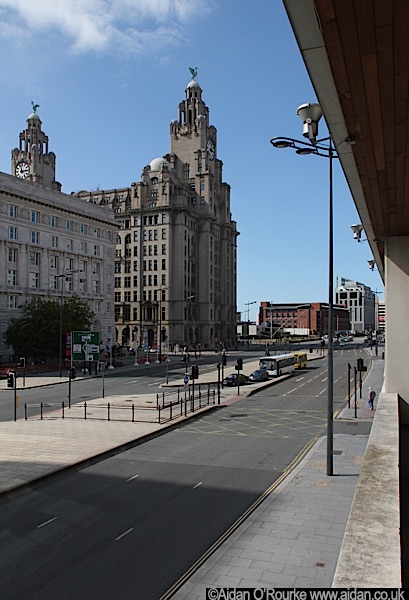
The Royal Liver Building is the most famous building in Liverpool and it is admired and loved by both local people and visitors. It’s located on the Pier Head, overlooking the River Mersey. Its two clock towers, and the two iconic Liver birds standing on top of them, can be seen from all over the city. It was constructed between 1908 and 1911 and is one of the so-called Three Graces. The other two are the Cunard Building, built 1914-1917, and the Port of Liverpool building, 1904-1907.

The Liver Building is one of the most familiar sights in Liverpool and you’ll find plenty of information about it in tourist guides and on websites. But certain facts about the Liver Building are shrouded in mystery, and there are some questions to which I’ve not found any clear answers. I will list them at the end.

1. The Liver Building is made out of reinforced concrete with a granite façade.

You’ll read that the Liver Building is made out of reinforced concrete. Its use of reinforced concrete for the structure of the building was ground-breaking at the time it was built. But it’s also important to know that the exterior is clad – or covered – in granite. The granite has a pale shade of brown, unlike the white Portland stone used on the Cunard and Port of Liverpool buildings. I’ve heard people say this colour is not very attractive but I don’t find that. It’s part of its unique character.

2. The Liver Building is built on one-third of a filled-in dock.

I used to wonder, why is it that on Liverpool’s Pier Head, there are three magnificent buildings, rectangular in floor plan, standing side by side? And then I discovered that all three were constructed on what used to be St George’s Dock. It was drained and the site was prepared for new buildings.

Water Street and Brunswick Street were extended across the former dock, dividing it into three. Three buildings then appeared where ships used to moor. And here’s another hidden fact: if you turned the clock back a few centuries, and looked from St Nicholas church, the Three Graces would be out in the river. The entire Pier Head and dock system is built on reclaimed land.

3. The inner courtyard walls have been covered with a modern glass façade.

In 2011, I visited the Liver Building to take photographs for the book ‘Liverpool Then and Now’, and I was shocked to discover that the interior facade has been covered in a glass skin similar to a 1960s office block. I didn’t take a photograph of it, as I didn’t want to spoil the image I had in my mind. Since its completion in 1911 the Liver Building, like most commercial buildings, has been altered and renovated, but I’m not sure when the glass wall was added. That’s another one of my questions at the end.

4. The riverside clock tower has three faces, the landside tower has only one.

I’ve been looking at the Liver Building for many years but had never quite fully noticed that the four clock faces are split between the two clock towers. On the west tower, there are three clock faces looking north, west and south, respectively.

On the east tower, there is only one clock face, looking east over the city centre. And here’s another hidden fact: all four clocks are controlled by the same mechanism. I don’t quite understand how that works, so that’s another question, which I’ve added to the list at the end.

5. The clock faces are bigger than those on the clock tower of the Palace of Westminster in London.

The clock faces of the Liver Building are bigger than the ones on the clock tower of the Houses of Parliament, completed in 1859. These are 23 feet or seven metres wide but the Liver Building clock faces are 25 feet wide or 7.6 m.

One information source stated that the clock on the front of Shell Mex House, further down the Thames, is bigger. But it’s not a proper clock face, just a section of the façade onto which clock hands and hour markers have been fixed. The Liver Building clock faces are proper clock faces made of metal and opaque glass, and they are recognised as the biggest in the UK.

The Pier Head and Three Graces, Liverpool

The Wrigley Building, Chicago

6. It looks similar to some early skyscrapers in the United States.

The Liver Building is said to closely resemble the Allegheny Court House in  Pittsburgh, built in 1884 and Adler & Sullivan’s Schiller Theatre in Chicago, built in 1891 and demolished in 1961.

I think it looks very similar to the Wrigley Building in Chicago, but that building dates from 1924. Could the Liver Building have influenced architecture on the other side of the Atlantic, just as Birkenhead Park influenced Central Park in New York?

7. The clock faces are the largest electronically driven clocks in the UK.

The Liver Building clocks are the biggest electronically driven clocks in the UK and this is a reminder that the building brings together both traditional and modern elements. The ornamented clock tower conforms to classic architectural principles you’ll see in world architecture, including Islamic architecture, but the mechanism of the clock is pure 20th century.

8. There are no bells inside the towers of the Liver Building.

There are bell towers on town halls and cathedrals including Liverpool Anglican Cathedral, and you can often hear them ringing. But inside the clock towers of the Liver Building, there are no bells. It made no sound at all until 1953 when a chiming mechanism was installed in memory of Royal Liver staff killed during two world wars.

The chimes were made using piano wires hit by hammers and the sound was amplified using a microphone, amplifier and speaker. This device gradually deteriorated and was out of operation for around four years. But in 2016, the chimes returned, thanks to the Cumbrian Clock Company, who are responsible for the maintenance of the clocks. They recorded the old chimes and saved the audio onto a hard drive. This sound is played throughout the day and the evening through a large speaker located under the cupola of the west tower.

It doesn’t sound quite like a real bell, but it’s better than no bell at all. I was intrigued to discover that when the building was under construction, there had been plans to put real bells in the tower and some space was set aside to accommodate them. But in the end, no bells were installed for fear that they would be too heavy for the new style of construction using reinforced concrete.

9. The Liver Birds were designed by a German.

This fact was remained hidden for many many years. It was only in recent years that the identity of the person who created the metal cormorant-like birds was revealed. He was Carl Bernard Bartels, a German emigré artist born in Stuttgart. He came to live in England in 1887 after falling in love with the country. A competition was held to design and build the two birds that would be placed on the roof of the Liver Building, and he won.

A few years after the Liver Building was completed, the First World War began and there was a strong anti-German feeling. Carl Bernard Bartels was interned on the Isle of Man as an enemy alien and deported in 1918. He returned to England in the mid-twenties and spent the rest of his life there. Carl Bernard Bartels created Liverpool’s most famous pair of icons, but this fact was kept hidden until the late 20th century because he was German. Inside the Liver Building, there is now a plaque in his honour.

So, those are what I believe to be the surprising facts – at least, they surprised me when I first found out about them. Let’s continue with more generally known facts.


10. The Liver Building was designed by local architect Walter Aubrey Thomas

The Royal Liver Building was designed by Walter Aubrey Thomas, a Liverpool-based architect who was born in New Brighton, Cheshire in 1864. He designed many buildings in Liverpool city centre. I was interested to discover he designed a listed building on Lord Street which has distinctive stripes and an arch.

The Liver Building and the Tower Building 22.05.2005

The Liver Building and the Tower Building 22.05.2005

I took a picture of the Liver Building from the corner of Water Street, zooming in on the clock tower. There’s another building to the right, a white building. That other building is the Tower Building, which pre-dates the Liver Building by several years. You can see it in old photos. It’s quite similar, with arches and those ‘curled’ motifs. In fact, the Tower Building was also designed by Walter Aubrey Thomas, something that is rarely mentioned, even though it stands directly opposite the Liver Building and could be seen as its precursor.

11. The Liver Building is a listed building, part of the UNESCO World Heritage site.

The Liver Building is a Grade 1 listed building (not Grade 1*, as one person mentioned. There is only Grade II*). A Grade 1 listed building is recognised as being of outstanding architectural merit and of national significance. That’s certainly true of the Liver Building.

It was also recognised as an important part of the UNESCO World Heritage site, the Liverpool Maritime Mercantile City. That supposedly put the area on a par with the Taj Mahal, the Pyramids and Angkor Wat. Controversially, UNESCO withdrew its status in July 2021 because officials were of the opinion that the site was under threat due to proposed construction projects nearby, including the new Everton FC stadium.

12. The clock faces have no numerals.

This may seem of little importance at first sight, but if we look at other historic clock towers, maybe ones that are slightly older, we find that most have numerals, either Arabic or Roman style, like the town halls of Birkenhead, Bradford, Rochdale and the Tower of Westminster (‘Big Ben’). With its plain clock faces, the Liver Building clocks look towards a more modern style.

13. The Liver Building clocks are called the George Clocks.

They’re called the George clocks because they were set in motion at 1.40 pm on Thursday, 22 June 1911, when George Frederick Ernest Albert Saxe-Coburg-Gotha, the Prince of Wales, officially became King George V. The clocks were made by Gent & Co of Leicester.

14. One of the clock faces was once used as a dinner table.

There is a photograph of one of the clock faces, which was turned into a huge banqueting table during the construction of the Liver Building. Sitting at the table are senior people from the Liver Assurance Group and Liverpool Corporation. The clock faces were later hauled up to the top of the building.

15. For many years it was the tallest building in Britain.

The Liver Building is said to be the UK’s first skyscraper, though at just 13 storeys, it doesn’t seem like much of a skyscraper. Already buildings in the United States were reaching much greater heights. But it remained the tallest building in Britain for many years. It’s 322 feet or 98.2 m to the top of the spires. It remains one of the tallest buildings in north-west England.

Composite images of the tallest towers in NW England 05.05.2006

Composite images of the tallest towers in NW England 05.05.2006

16. Each of the two Liver Birds holds something in its beak, but what is it?

The birds on the Liver Building have a wingspan of 24 feet or 7.3 metres and are 18 feet 5.5 metres high. If you look closely or zoom in with a camera, you will see that each Liver Bird is carrying something in its beak. It looks like a small twig or branch of a tree. It’s got four leaves. In most descriptions, this is identified as a piece of laver, or seaweed. The name ‘laver’ is a pun on the name ‘Liverpool’.

However, I’ve also read that it’s an olive branch. And the French language Wikipedia page states that the Liver bird holds in its beak a branch of genêt, the French word for broom, a type of bush with a yellow flower that appears in spring. Genêt is said to be a reference to the Plantagenet dynasty, who ruled England in the middle ages. Is this true? That’s another question to add to my list at the end! The Liver bird is a mythical bird, said to date back to 1207, when King John founded the borough of Liverpool by royal charter and used a bird on the seal.

17. It is named after the Royal Liver Assurance Company, but they are no longer in the building.

The building is named after the Royal Liver Assurance Company which was a friendly society.  Around the turn of the 20th century they decided to construct a new building for their 6000 staff. It remained the headquarters until Royal Liver Assurance merged with the Royal London Group in 2011. The group subsequently moved out of the building. In 2019 it’s reported to accommodate around 2000 staff working in a range of companies.

Luxembourg-based investment group, Corestate Capital, bought the building for £48 million in February 2017 along with Everton F.C. majority shareholder Farhad Moshiri. So, Liverpool’s most potent and best-loved symbol is a privately-owned office building. That’s an interesting fact. There must be very few other commercial office buildings with such an exalted status. Perhaps it’s symbolic, because Liverpool is a mercantile city whose wealth is built on business and trade (including, sadly, the slave trade).

18. The Liver Building was renovated in 2019 and also in the past.

In 2019, the Liver Building was renovated to bring it up to the standards required by today’s companies. Looking on the royalliverbuilding.com website, I see many changes have been carried out. There’s a photo of empty floor space with those semi-circular windows. But the building has not been preserved in its original state. That’s the way it is with working buildings, they have to be adapted for changing times, though seen from the outside, it looks as it did when it was first built.

Liverpool Liver Building and Pier Head with St Nicholas church

Liverpool Liver Building and Pier Head with St Nicholas church

And now we move from facts to popular legends.

19. The birds are called Bella and Bertie and if they fly away, Liverpool will cease to exist.

I’ve read from many sources, that the birds are called Bella and Bertie, but who exactly called them that? We are told that if they break away from their shackles and fly away, that will be the end of Liverpool. This story sounds like it was inspired by the ravens of the Tower of London. It’s said that if they leave the tower, the kingdom and the Tower of London will fall.

The difference is that the ravens are real birds, whereas the Liver Birds are copper sculptures weighing several tons and they’re tied down with cables. The birds face in opposite directions. It’s said that if they were facing each other, they might mate and break their moorings, causing the downfall of the city. According to another account, Bella watches over the ships and their crews while Bertie watches over the city and its people.

A variant of this is that Bella is on the lookout for handsome sailors on the arriving ships, while Bertie is checking that the pubs are open. What must he have been thinking during the 2020 Coronavirus crisis! A typically Scouse piece of humour is that the Liver Birds flap their wings every time a virgin walks along the Pier Head.

Panoramic view of Liverpool from Royal Liver 360 - 22.06.2019

Panoramic view of Liverpool from Royal Liver 360 – 22.06.2019

20. The views from the top of the Liver Building are fantastic!

There is no doubt that the views from the roof of the Liver Building are fantastic. When I wrote the previous version of this article in 2015, it wasn’t possible for the general public to enter the building and go up to the tower. Now it is! Read my review below to find out what I thought of the Royal Liver 360 visitor experience and why I was a little bit disappointed.

In 2019 Royal Liver 360 Tower Tours and Visitor Experience opened its doors. For the first time, visitors were able to go inside the building and ascend to the top of the tower. I did this in summer 2019 and I wasn’t disappointed, though I have one criticism! So here’s my quick review of the Royal Liver 360 tour and visit to the top of the building.

Liverpool City Centre seen from the top of the Liver Building-22.06.2019

Liverpool City Centre seen from the top of the Liver Building-22.06.2019

I booked in advance on the website. The ticket cost £16. The journey to the top of the building starts in the basement. The entrance is to the right of the main entrance to the Liver Building. In the reception area, there is a ticket desk and an exhibition, which is worthy of a visit in itself. There’s an impressive wooden model of the Liver Building. On the display boards, there’s information about the history of the building with many photos.

Soon it was time to start the tour. Visitors are assigned into groups and led by a friendly guide. At this point, we notice that the health and safety procedures are rigorous. There is a briefing, warning of potential hazards and telling us what to do in an emergency. This is quite different from other older attractions.

I realise it’s for our safety but it does impinge a little on the experience. The guide counts some of us into the lift and we go up. We wait for the others and then proceed out onto a balcony below the south clock face. Here we get our first glimpse of the cityscape and of one of the Liver Birds – it’s Bertie, the one facing out over the city. We can’t see Bella, she stands hidden above the tower. Our guide provides information and plenty of humorous remarks.

Next, it’s time to go up the stairs and into the interior of the clock tower, with its clock faces on three sides. In this room high above Liverpool, they’ve created an auditorium with speakers and digital projectors. Soon the lights go down.

What follows is a state-of-the-art presentation on the history of Liverpool and the Liver Building from its construction at the beginning of the century, through two world wars and up to the present day. The visuals are good, including animated 3D Liver Birds as well as many still and moving archive images. The sound is immersive and very loud. We hear the foghorns of the ships, the bombs of WW2 and finally, the song ‘Ferry Cross the Mersey’ by Gerry and the Pacemakers. It presents Liverpool perfectly and truly expresses the pride people have in the city.

View north from the Liver Building roof 22.06.2019

View north from the Liver Building roof 22.06.2019

Now, it’s time to go up to the top floor via a narrow staircase. Emerging into the daylight, we walk out onto the balconies and start to admire the panoramic views: the city centre to the east, the Pier Head, Albert Dock and River Mersey to the south, the view west across the river towards Birkenhead and the Welsh mountains and to the north and north-west, the docks, New Brighton and the Irish Sea. We are standing below the dome with Bella standing on top. We still can’t see her, but we can see Bertie on the other tower, standing with his back to us. He’s not being rude, he’s got an important job to do.

Many times I’ve looked across to the Liver Building from all parts of the city and from across the river.  Now it is stunning to see the view in the other direction. I start to take photos and videos, moving around each balcony and back again. I’m about to start a video shot of the city when…

“The tour is finished now, can you make your way back down the stairs…”

And that’s my only criticism of the Royal Liver 360 tour. You are only allowed, I think it was around 10 to 15 minutes at the top before being asked to leave. I spent a whole evening on the Shard in London and a similar amount of time and spent a few hours at the top of the Rockefeller Center in New York.

Fifteen minutes at the top of the Liver Building just isn’t enough time. I realise there are space limitations as well as health and safety considerations, but I would pay extra to spend more time up here and I’m sure a lot of other people would too. Royal Liver 360 bosses, please take note!

A few minutes later I’m back down on the Pier Head again, looking up at the iconic clock tower and hoping for an opportunity to spend a longer period up there some time in the near future.

Looking up at the facade of the Liver Building

Blick nach oben auf die Fassade des Liver Building

Personal observations and reminiscences.

The Liver Building was begun in the same year my father was born, 1908. He was christened Bertie, presumably after the popular name of George, who became King in 1911.

I remember visiting the Pier Head with my mother in the 1960s and taking the ferry to Woodside. I was captivated by the Cunard Building and the Port of Liverpool building. They had just been cleaned and looked as if they were made out of icing sugar. They seemed to ‘sing’, I can’t quite explain it. At that time, all the buildings in Manchester were still covered in black soot from the factories. I can’t remember much about the Liver Building, except that there were rows of green Liverpool Corporation buses parked in front of it.

Liver Building sketch by Aidan O'Rourke

Another memory from the sixties is the opening credits of the Liver Birds tv series, starring Nerys Hughes and Polly James. The grimy Liver Building can be seen from the ferry. There is an iconic shot looking up at the glamorous Nerys Hughes standing on the back of a bus, with the tower of the Liver Building behind.

In recent years I’ve followed all the changes on the Pier Head, I’ve taken photos and video of many festivals, including the Giants, I took ‘now’ shot of the building for the book ‘Liverpool Then and Now’ and went inside to capture the view of where the Liverpool Overhead Railway used to be. That’s when I saw the glass interior wall for the first time.

I’ve done some drawings too, which I am featuring on this page.

I love the Liver Building, its design, its location, the Liver Birds that stand on top of it, and all the associations it has with the history of Liverpool. I will go on admiring it and taking photos of it, like every local person and every visitor to the city. I hope to find out even more hidden facts about the Liver Building, which I will add to this page.

  • But I have some unanswered questions, some facts about the Liver Building that remain hidden, or at least not 100% clear. Can you provide any information?
  • Who exactly named the Liver Birds Bella and Bertie?
  • How are the four clocks, including one in a separate tower, controlled by one mechanism?
  • Exactly what type of branch are the Liver Birds holding in their beaks?
  • Which clock face was the one used as a dinner table?
  • Since when clock tower had an amber coloured light? I seem to remember that in the past, the light was white. Was it?
  • When was the earlier renovation carried out, during which the glass interior façade was added?
  • In what year were the Three Graces first cleaned? Was it in 1968?
  • What is the exact weight of each Liver Bird?

And here’s one extra fact: At around 11 pm on the evening of Friday 26 June, 2020, while crowds celebrated Liverpool FC’s Premier League win, someone threw a firework at the Liver Building and it started a fire on the front of the building. Mobile phone images show a blaze in front of the semi-circular window below the west tower. The fire was put out by Merseyside Fire and Rescue Service. Comment: Setting fire to Liverpool’s most iconic building is not the best way to celebrate Liverpool FC’s win.

Deepen your knowledge of Liverpool by watching more AidanEyewitness videos. Click ‘YouTube’ to watch on YouTube and don’t forget to ‘like’ and subscribe!

Filed Under: AidanEyewitness YouTube channel, Sidebar Display Tagged With: Carl Bernard Bartels artist, How tall is the Liver Building?, icons of Liverpool, information about the Liver Building, Liver building clock, Liver Building Liverpool, Liver Building tour, Liverpool Artists, Liverpool attractions, liverpool liver bird building, Liverpool Liver Building 360, liverpool liver building photos, Symbols of Liverpool, the Royal Liver Assurance Company, Three Graces, What are the Liver Birds made of?

Video: My first Manchester Building Boom video

2020-10-26 By Aidan O'Rourke

I made this video in autumn 2020. It was the first video of my Building Boom series. I had made videos on other themes related to Manchester and Liverpool but was surprised when this video suddenly attracted many more views than any of my previous videos.

I went on to produce many more videos on a similar theme for both Manchester and Liverpool and I will continue to follow the theme as new development proceeds. I intend also to visit other cities.

Here are some excerpts taken from the script of the video.

In Manchester, for quite a few years now, a massive construction boom has been going on. From a distance, for instance from the airport some 8 miles or 13 kilometres to the south, the new towers of Deansgate Square are clearly visible.

On brownfield sites, we can see new city districts, commercial developments, office buildings with co-working spaces, apartment buildings, multi-storey car parks, shops, cafes, restaurants, gardens and infrastructure such as access roads, footpaths and pedestrian bridges being built

In Manchester, building regulations are different to other major British cities. There are no height restrictions. The city’s planning department gives the project developers free rein.

Manchester CIS Tower

In the 1960s, Manchester got the CIS Tower and a few other high-rise buildings. In the 80s and 90s, development in the city remained dormant.

On the 15th of June 1996, an IRA bomb exploded on Corporation Street. It destroyed an entire city district. Fortunately, no people were killed, although around 200 were injured.

In the years that followed, a large part of the city centre was rebuilt. Unfortunately, some historic buildings were lost during this time. They were soon forgotten and the transformation of the city continued.

In 2006 the Beetham Tower became the tallest building in Manchester, overtaking the CIS building.

Since then, many tall towers have appeared. There are several “hotspots” where new construction projects are reaching higher and higher into the sky.

The most spectacular example is located a little bit south of the city centre.


.
The Deansgate Square development consists of four towers of various heights.

In 2018 the South Tower became the tallest building in Manchester at a height of 201 metres or 660 feet, with 65 floors. The project is being developed by Renaker.

Several new projects offer only rental apartments, plus facilities such as fitness centres, restaurants and communal areas.

So how will the emerging new Manchester look? Will all income groups have a share in it? Will the new ‘Manc-hattan’ be a place where people will want to stay or will they later move out into the suburbs to live in a house? How long will the construction boom last? What effect will the corona crisis have on the development of Manchester.

To find out, please keep watching my channel AidanEyewitness.

Filed Under: AidanEyewitness YouTube channel, Sidebar Display

Video: The UK and German healthcare systems compared

2020-10-08 By Aidan O'Rourke

I am a coach in languages and I’m keen to explore issues concerning the UK and Germany. This presentation is mostly in English but I also include some examples of German words and phrases to do with healthcare. You can’t talk about healthcare in Germany without using some German.

Following a suggestion from a fellow pro-European campaigner, she was campaigning in favour of the NHS, I decided to look at the question of how the UK’s National Health Service compares to the health system in Germany.

This is just a very brief overview of a complex subject. I’m going to give some personal opinions as well as general information based on my research. There are some statistics as well.

I’ve tried to ensure everything is factually correct, though some information may not be completely accurate and it will go out of date.

Revised version published by Aidan O’Rourke | Sunday the 30th of August, 2020

So which health system is better? The British NHS or the German healthcare system?

Es ist kompliziert! It’s complicated!

OK, so what is the fundamental difference between the UK system and the German system?
The UK’s NHS is owned and run by the state and it’s free at the point of use.

The German system is mostly free at the point of use but it’s paid for through contributions to a health insurance scheme that’s closely regulated by the state.

The money to pay for your healthcare is taken directly out of your salary. The amount appears on your wage slip. This money goes into a health fund – ein Gesundheitsfonds and then into your chosen Krankenkasse or health insurance ‘pot’. In the UK, the money to support the health system is provided by the government, mostly through general taxation.

The NHS was launched in 1948 at what was then called Park Hospital in Urmston near Manchester. Today it’s Trafford General Hospital. A blue plaque commemorates the launch.

British people are proud of their NHS and they often compare it to the US system. They like the fact that it’s free, unlike the American system which relies mostly on private health insurance.

Aneurin Bevan – he was from Wales and that’s a Welsh name – was Labour health minister from 1945 and he is credited as the father of the NHS. There’s a statue of him on Queen Street in the Welsh capital, Cardiff.

The Charité hospital, East Berlin (GDR) 1985.

The UK system is more like the old GDR system and that’s not a criticism. The East German health system provided a good, basic service, though without the expensive equipment found in the West.

After the end of Communism – nach der Wende – the West German system was introduced into the East.
The German system goes back to the late 19th century, when under Otto von Bismarck, Germany pioneered the welfare state.

That system is still in use today. Krankenkassen are non-profit making organisations that are governed by strict regulations.

The biggest state-run Krankenkasse is the Allgemeine Ortskrankenkasse – which you could translate as the general local health insurance organisation. It’s not easy to translate so we’ll just say Krankenkasse.

You’ll find a wide range of private Krankenkassen offering a range of health insurance packages at different contribution levels.

You are required by law to pay into a Krankenkasse. If you earn above a certain amount, you can insure yourself with a private Krankenkasse. Many cater for specific professions.

Birmingham Queen Elizabeth Hospital

Birmingham Queen Elizabeth Hospital

In the UK, the National Health Service is paid for by the government. The amount paid by the government varies depending on which political party is in power.

Statistics indicate that the NHS received considerably more money under Labour governments than the Conservatives, though of course, the Conservatives dispute this.

Uniklinik Köln / Cologne

Cologne Uniklinikum

It’s important to note that the UK also has a private healthcare system which people can gain access to by paying for private health insurance. People also receive private healthcare as a benefit or perk of their job.

So in theory, whether you are in Germany or in the UK, if you have a higher income and/or a better job, you can get better healthcare by paying more.

The NHS has had a funding crisis for many years – German system is not perfect but it’s well-funded.
Due to Brexit, the NHS now has a serious staffing crisis. Many staff have left and fewer people than before are being recruited from the rest of Europe.

Brexit is bad for the NHS for three reasons: The staffing problems, the effects on the NHS of a possible US trade deal and simply the fact that the NHS is paid for through ongoing taxation.

Brexit is costing the UK a huge amount. Less money from taxation means less money for the NHS.
The claim by the Leave campaign that the UK sends £350m a week to the EU and that this money can instead be paid to the NHS was false and deliberately misleading.

Which hospitals are reputed to be the best in the UK and in Germany? I don’t think it’s possible to give a reliable answer to that question, but there are certainly some famous hospitals: in the UK, Guy’s Hospital in London, Queen Elizabeth Hospital, Birmingham, The Christie in Manchester and more.

In Germany we would think of the Universitätsklinikum Heidelberg, the Charité in Berlin, Asklepios Klinik Barmbek – Hamburg and the Uniklinikum Köln, are all highly regarded. And by the way Klinik in German can refer to a hospital, not just a small health centre, as in English.

So what are the practical differences between UK and German hospitals? To gain an impression, I went for a walk around a few hospitals in the UK and in Germany.

One thing I noticed walking around the Uniklinik in Cologne is that each department or unit functions as an independent practice. For instance I saw a Notfallpraxis – an emergency practice for children and young people.

In the UK most departments and units display the NHS logo. Healthcare services including hospitals, health centres and emergency ambulance services are organised under NHS trusts. An NHS trust is a non-profit making organisation set up to provide healthcare services.

As of April 2020 there are 217 trusts, and they employ around 800,000 of the NHS’s 1.2 million staff, information from Wikipedia.

Many hospitals in Germany are run by religious organisations, such as the Evangelische Kirche, Germany’s Lutheran Protestant church.

Fresenius Medical Care, Stockport NHS Dialysis Unit

Some medical services are provided to the NHS by outside companies, for instance Fresenius, a German-based company that provides dialysis services.

At UK hospitals you’ll see adverts for fundraising – which is often needed to pay for basic hospital equipment, such as scanners.

In Germany you just don’t see this. Pretty much all the main medical services in Germany are fully funded. This is especially true of hospices. St Ann’s Hospice near Manchester receives just over a third of its funding from the NHS. That means it needs to raise around £20,000 every day just to keep the hospice running.

They organise glamorous celebrity dinners, midnight runs and many other events. They also run charity shops, but is it right that a facility providing a basic healthcare service needs to do this to raise money? In Germany hospices are fully funded.

Here are some more differences I found: The emergency ambulances in Germany have a two-tone sound, but in the UK, they have an oscillating tone. The German siren is called the Martinshorn, named after the company that makes it.

In the UK the emergency ambulances are yellow and green and in Germany they’re red, like the trains. In both countries you’ll often see the same basic vehicle, the German-built Mercedes Sprinter.
On the side of the ambulance in the UK, you’ll see the emergency number 999 and you can dial 111 for non-emergency medical issues and advice.

Ambulances in the UK and Germany

In Germany and other mainland European countries, the emergency number for fire brigade and ambulance is 112. The 112 number also works in the UK and on any GSM phone anywhere in the world.
In recent years in the UK, smaller hospitals have closed and their services, including A&E – Accident and Emergency – have transferred to larger single-site hospitals.

At hospitals in Germany, car parking is generally free for a period, then there’s a charge. This is also the case in Britain, though some have very expensive charges, for instance Stepping Hill hospital in Stockport.

Examples of hospital parking charges UK and Germany

If you are a citizen of another EU state visiting Germany, you can receive healthcare on the same basis as German nationals

This is one of the many advantages of EU membership. The cost of any treatment is charged to the home country of the visitor.

You can travel throughout the whole of the EU plus some additional countries, and receive treatment on the same basis as nationals. It’s not necessary to take out medical insurance, as you do when travelling to the United States, for instance.

I once had a bike accident in Germany, and I was given first class treatment at the local hospital. I just showed them my British passport, the bill was charged to the UK. I didn’t have to pay anything.

The loss of this intelligent and cost-effective healthcare arrangement for the UK and its citizens, especially older people living in other parts of Europe, is one of the many dreadful consequences of Brexit.

If you’re from the UK and suffer illness or have an accident in Germany, you will, thanks to Brexit, most likely have to pay for it yourself, or buy travel insurance before you leave.

At least you’ll be able to gain first hand experience of healthcare in Germany and so you’ll be better able to answer the question of which country has the better system, the UK or Germany.
In the course of my research I found an interesting video on the BBC website with some useful information:

Waiting times for operations are shorter in Germany, typically three to four weeks. In England most people have to wait 22 months for orthopaedic operations. Orthopaedic, that’s the branch of medicine that deals with problems of bones or muscles.

  • Germany has three doctors per 1000 population. The UK has two.
  • Germany has three times as many hospital beds compared to the UK.
  • Germany spends 11.7% of its GDP on health, Britain 10%.
  • Most Germans pay 7% of their income for healthcare. Their employer pays the same.

Most people I’ve spoken to who are familiar with the German healthcare system say it offers a higher standard of service.But people in Germany have to pay for their system directly out of their salary. Some pay many hundreds of euros each month. That’s possible because of Germany’s strong economy.

The British healthcare system provides a good service, and though people don’t pay contributions directly towards the health system, the NHS is paid for through taxation and a share of National Insurance contributions.

Despite its current difficulties, the majority of people in Britain are proud of their health service and they appreciate the work done by medical professionals at all levels.

By a large majority they still support the original idea of the NHS, that is, to provide universal healthcare that’s free at the point of use.

So that’s it, a quick, hopefully informative and maybe entertaining overview of a very complex subject, which I hope will arouse your curiosity to find out more.

If you’re interested in learning German, go to www.aidan.co.uk.

If you’re visiting Germany, I wish you gute Reise! and if you’ve visiting the UK, enjoy your trip. And to all EU nationals visiting another EU country, don’t forget to bring your EHIC card!

Here’s the link to the BBC video I found.

Filed Under: AidanEyewitness YouTube channel, Language learning, Sidebar Display Tagged With: British hospitals, das britische Gesundheitswesen, das deutsche Gesundheitswesen, doctors in Germany, German health system, German hospitals, travelling in Germany, UK healthcare

The Welsh influence in Liverpool

2020-10-07 By Aidan O'Rourke

AidanEyewitness YouTube Channel

There are many connections between Liverpool and Wales. It’s said that Liverpool is regarded by many people in North Wales as their capital, not Cardiff. The Welsh accent has influenced the Liverpool accent, and the border with Wales is just twelve and a half miles down the road from Birkenhead. You can see the Clwydian hills from many parts of the city including Toxteth in the south.

Looking west along Althorp Street, Dingle, Liverpool with a view of the River Mersey, the Wirral and the Clwydian Hills in the distance

The view over the Liverpool region from the A55 in Flintshire, North Wales, is magnificent.

Welsh people started to migrate to Liverpool in the 18th century. In 1813 around 8000 people or 10% of the residents of Liverpool were Welsh.

They created communities around the city and Welsh was the dominant language in those places.

As in other British cities there are streets named after places in Wales such as Denbigh Road in Walton und Barmouth Way in Vauxhall.

But the most important symbol of the Welsh influence in Liverpool is the area called the Welsh streets in Toxteth, next to Princes Park, about a 10 minute bus ride south of the city centre.

The street names, and I’ll try and say them Welsh-style, include Wynnstay Street, Voelas Street, Rhiwlas Street, Powis Street, Madryn Street, Kinmel Street, Gwydir Street, Pengwern Steet, Treborth Street, Dovey Street, Teilo Street and Elwy Street.

These streets were built by Welsh building workers during the 19th century. The houses were designed by Welsh architect Richard Owens, who also designed many terraced houses in Liverpool as well as churches in North Wales.

Over the years the area became became run down. In the 2000s, there was plans to demolish the Welsh Streets, including the house where Ringo Starr was born – 9 Madryn Street. Local residents were generally in favour of refurbishment rather than demolition. The houses were vacated and prepared for being pulled down.

9 Madryn Street before 06.05.2018 renovation

9 Madryn Street 06.05.2018 before renovation

Beatles tours continued to the area, fans wrote messages on the front of the boarded up house.

The organisations SAVE Britain’s Heritage and the National Trust campaigned for the area to be renovated, especially because of its significance in the story of the Beatles.

A new plan was drawn up by Placefirst, a company based in Manchester that designs, builds and refurbishes homes for rent. Around three quarters of the houses in the Welsh Streets have been retained and renovated. Today, Ringo Starr’s old house looks almost new.

In October 2019 the Transformation of Welsh Streets by Placefirst was named UK’s Best Residential Project in the Royal Institution of Chartered Surveyors awards.

The Welsh influence in Liverpool declined during the 20th century. According to the 2001 census, around 1.17% of the population were born in Wales, but there are plenty more people in the city who have Welsh ancestors.

For me the clearest evidence of the Welsh influence in Liverpool is the accent. The up-and-down intonation of the Scouse accent is similar to the Welsh accent in English or with the Welsh language, yr iaith Gymraeg. In the Scouse accent, we can literally hear the influence of all those people who migrated from Wales to Liverpool in past centuries.

There’s also an Irish influence on the Liverpool accent but that’s another story.

The patron saint of Wales is Saint David, or Dewi Sant in Welsh. Saint David’s Day is celebrated every year in Liverpool, in Wales and around the world, on 1 March.

After sunset over the Mersey, Liverpool

Filed Under: AidanEyewitness YouTube channel Tagged With: accents, language, Liverpool, Liverpool Welsh, Merseyside, North Wales, scousers, Wales heritage, Welsh culture, Welsh language

The amazing history of Gander Airport, a visual Podcast

2020-09-23 By Aidan O'Rourke 1 Comment

Article and Visual Podcast in English and German versions

CLICK TO TO GO TO THE GERMAN VERSION

Why was the airport that was once the biggest in the world built in the middle of a wilderness? The answer is actually quite simple.

Gander International Airport is situated on the island of Newfoundland in the north-east of Canada

The airport was built in the 1930s north of Gander Lake around 60 km west of the coast which is often fog-bound. There was also a railway line there.

The range of the aircraft of that time was insufficient for direct flights between Europe and North America. They had to make an intermediate stop and refuel.

Gander and also the Irish airport Shannon became important springboards across the Atlantic. Both airports lie on the route between north-west Europe and north-east America, the shortest connection between the two continents.

Building work began in June 1936. At that time, Newfoundland was a self-governing British Dominion. The town of Gander was built to house the building workers and airport employees.

The first aircraft landed on the 11th of January 1938. In November of the same year operations began. Four paved runways were built, the longest named 03/21, with a length of 10,200 feet or 3109 metres.

After it opened, Gander quickly became biggest airport in the world. In the Second World War, the Gander station of the Royal Canadian Air Force was of great strategic importance.

On the 10th of November 1940 seven American military aircraft departed on a test flight from Gander to Belfast. All seven landed there safely.

After that, more than 20,000 fighter planes flew from the USA to Europe, with a refuelling stop in Gander. Supplies were brought to Britain and to the European front.

Approximately 20,000 people from the U.S. Air Force lived around the airbase.

After the war the local authorities regained responsibility for the airport and it wasn’t long until civilian aviation started.

At that time flying was risky. The strict safety standards of today did not exist.
Despite the risks, more and more people wanted to fly. Soon the big propeller airliners of BOAC, Pan Am and TWA were making the flight across the Atlantic.

At that time the journey from London to New York could take up to 18 hours.

Gander became the hub of commercial aviation ‘Crossroads of the World’ was the slogan.

In the 1950s, 13,000 aircraft carrying 25,000 passengers landed and took off every year at Gander airport.

The passengers at this time were often privileged people, such as film stars and leading politicians.

In the boom years, the rich and famous came into the improvised departure lounge, where they drank cocktails and were photographed. Clark Gable, Marilyn Monroe, John Wayne, Elizabeth Taylor and Winston Churchill were visitors to Gander.

On the 29th of June, 1959 a new terminal was opened by the Queen, but the boom years were to end soon. The DC4s, Stratocruisers and Constellations of the 40s and 50s soon became outmoded.
The Boeing 707 revolutionised transatlantic air travel.

This jet aircraft had a range of 8000 kilometres and could cross the Atlantic direct from London to New York in only eight hours.

And so traffic at Gander decreased rapidly during the 1960s, but the airport was still important for military purposes.

In 1964 Jack James became Airport General Manager. He didn’t just work here, he lived here. The airport was his life and he devoted himself to the commercial success of Gander.

In the late 60s, he targeted the Eastern Block countries. Their Tupolevs and Ilyushins used too much fuel for longer flights.

Soviet Union IL62 stamp - Sowjetunion Briefmarke IL62 Flugzeug

Soviet Union stamp – IL 62 aircraft (public domain)

They flew regularly back and forth to Communist Cuba. Aircraft belonging to Aeroflot and the GDR airline Interflug became regular visitors to Gander.

Aeroflot came with around 60 flights per week. The crews were stationed at Gander. The Eastern Block airlines opened offices at the airport or in Gander.

Eastern Block heads of state such as Brezhnev and Honecker were personally welcomed by the airport director. Fidel Castro had his first ‘winter wonderland’ when as a guest of the airport management, he rode a toboggan in the snow.

Communist rulers were the new VIPs at the airport but their subjects saw an opportunity to escape.

After landing, the passengers always came into the terminal while the plane was being refuelled.

The waiting area did not officially belong to Canada, but if a passenger wanted to stay in Canada it was possible.

He or she could go to a member of the security staff and simply say the words ‘Save me’. That meant that the person was asking for political asylum.

From that moment on they were accepted by the Canadian authorities. The security police of the Communist country they had come from could do nothing.

In the documentary film ‘Gander, the airport in the middle of nowhere’ by Roland May, Wolfgang Jörn from Neubukow in the GDR describes how he and his girlfriend of that time flew from Berlin Schönefeld to Cuba.

They had however already decided that they would not be returning to their socialist fatherland.

GDR Interflug Ilyshin 62 aircraft

He describes how, on the return flight, he got off the Interflug plane in Gander and came into the waiting hall. He had brought his bag with him from the aircraft.

His girlfriend went to the security guard and said ‘Save me’.

Thankfully, he and his girlfriend were successful.

He still lives near Toronto and in 2018 he went back to his home town for the first time in thirty years.

When at the beginning of the 1990s, the end of Communism came the Eastern Block airlines had to close their offices. It was a sad time for colleagues on both sides.

The plane is the safest form of transport. We know that. The last major air crash near Gander happened in the 1980s.

On the 12th of December, 1985, a chartered Douglas DC-8 of the airline Arrow Air made a refuelling stop in Gander. It was bringing US solders who had been on a peacekeeping mission in the Sinai to Fort Campbell, Kentucky.

After take-off, the plane got into a stall and crashed. All 256 people on board were killed.

Presumed cause: Ice on the wings. Two other serious accidents took place near Gander: A Czechoslovak Ilyushin 18 in 1968 and a Sabena DC4 in 1946.

In the 1990s fewer and fewer International airlines came to Gander Airport. Its future seemed uncertain until in the north-east of the USA an unimaginable tragedy caused a crisis.

On the 11th of September 2001 after the terrorist attacks, 39 aircraft were diverted to Gander. 6122 passengers and 473 crew were stranded there and had to wait many hours in their aircraft.

Then the passengers were welcomed by the 10,000 inhabitants of the town of Gander. They were treated like members of the family. The guests and their hosts became close friends. When the time came to fly on, many parted with tears in their eyes.

In recognition of this, Lufthansa named its new Airbus 340 Gander/Halifax in 2002.

Nowadays not many aircraft land at Gander but at a height of 30,000 feet and above, around 1500 aircraft overfly Newfoundland on a normal day.

The control centre of the Canadian air traffic control for Canada and the North Atlantic, Nav Canada, is situated not far from the airport and is an important employer in the area.

Gander airport today is an airport for small passenger aircraft, private jets, regional airlines, freighters and military aircraft.

There’s an important flying school here: Gander Flight Training. It dates back to the year 1992, when its founder Patrick White bought a Cessna 150 and began as a flying instructor.

Today the school offers a wide range of flying courses. Students come from Canada and abroad to do their pilot training here.

With its long tradition in aviation, Gander is a place with a passion for flight. The people here are fascinated by planes and flying.

That makes Gander an ideal place for flight training. Newfoundland is a cold and often wet place with snow, ice and wind. Many people all over the world say, if you have learned to fly here, you can fly anywhere in the world.

But Gander like its sister airport Shannon, also has an important role as an emergency landing site for aircraft that get into difficulties over the Atlantic.

The coronavirus of 2020 brought new challenges for Gander and all other airports.

Gander International Airport has seen many highs and lows in the past.

Hopefully as the time moves on for this historic and remarkable airport, its future will remain secure.

CLICK TO TO GO TO THE GERMAN VERSION

Filed Under: AidanEyewitness YouTube channel Tagged With: Canadian airports, cold war history, Communist airlines, gander airport, GDR Interflug, history of Gander, Interflug Berlin to Havana, Newfoundland airports, transatlantic flights

CP Lee interview on the history of music in Manchester

2020-08-02 By Aidan O'Rourke

Interview, transcript & photos, Multimedia Presentation


I recorded this interview with CP Lee on Friday the 28th of July 2006 and the recording has been available on my aidan.co.uk site ever since. For some time, I’d been planning to do an improved version with better sound quality and with a transcript.

And then on the 25th of July, 2020 came the terrible news about Chris so I decided to move ahead and complete this improved version and here it is. It’s presented using my ‘talking book’ or ‘visual podcast’ style or it could be described as Audio Visual Magazine style. Words and images are presented side by side on screen. Most of the photographs are by me. A few are from public domain sources.

Please check the subtitles for foreign language translations, and also please like the video and subscribe to the channel.

Published by Aidan O’Rourke | Sunday the 2nd of August, 2020

Told you I was missing, but I wasn’t lost

and I was walking through streets in the cold and frost of Manchester.

Looking for the place that I used to know

and then I saw some people and it started to snow on Manchester.

Manchester Anthem by James Herring

What is it about Manchester that makes it such a pre-eminent city of music?
Well that’s the question that’s bothered musicologists for quite some time. It is a city that seems to be uniquely placed in the history of popular music, because it repeatedly jumps in feet-first into great music, great scenes, and on an international level. And we can look at places like Newcastle, Birmingham, Bristol, we see groups come from there, but it’s never as consistent as it has been from Manchester. And I think that that’s because Manchester, if you look very closely, you can see the tracer bullets being fired throughout history.

There’s always been a tremendous musicians’ infrastructure here in Manchester that’s enabled the different movements or genres or waves of music to happen and to continue and carry on so that one builds on the other. And we can look right back into the Industrial Revolution in the 19th century. Mancunians demanded and devoured music at an incredible rate.

We’ve got the birth of the Hallé Orchestra, one of the great international classical orchestras. It’s here in 1855, but you go back in 1780 the Gentleman’s Concerts is the beginning of the Hallé. They would get audiences of two and a half, sometimes five thousand people wanting to hear the latest classical music, which if you think about it is very punk. This stuff, it wasn’t classical then it was contemporary but they wanted to hear it.

Also mixed in with that you’ve got the Jewish elements, you’ve got Celtic elements, you’ve got folk elements, all of them pouring into the city, devouringpeople at an astonishing rate, but also producing culture at an astonishing rate. So if you look at say The Making of the English Working Class by EP Thompson, he writes at length about the creation of working class culture, and music was an essential part of that. It’s not particularly radicalised or political. It’s there as a release mechanism, it’s there as a carriage system to take you away for an evening into a transport of delight.

So by the 20th century, we’ve got the dance bands, we’ve got working-class unemployed jazz bands, groups of people playing kazoos, wearing costumes, trying to outdo each other. They’d go to a football pitch or a recreation ground, then you’d get different jazz bands. Each street would have one, neighbourhoods would have them, cities would have one and by the 1930s they’d have competitions against each other. Who were the best marching jazz bands?

By the 1950s, because of the Second World War we’ve got Burtonwood Aerodrome, Burtonwood American base, which is 25 miles away Manchester and it means that every weekend we get an influx of American musicians who are based there coming into Manchester, also going into Liverpool at the same time, and feeding into the groups that exist, principally, at that time, jazz bands. And the jazz bands were not your kind of Acker Bilk trad, these were modernists, these were people who were influenced by Charlie Parker, Dexter Gordon, and they wanted authentic black American players if they could get them, but they’d settle for white ones if they had the chops.

A great interest began in Manchester to trace jazz back to its roots and those roots come from folk blues, from whatever. And this led to an interest in people like Muddy Waters, Chicago R&B. So that at the end of the 1950’s, you’ve got a lot of groups who’ve come up watching the emerging rock and roll scene on television or at the cinema. They’ve come through skiffle, so they’ve got instruments, they can play them, but the music that’s being developed is beat music, which essentially a kind of white English version of R&B. But it’s music with a beat, it’s music for dancing to.

And we get by 1964, we can find over 200 beat clubs in the Greater Manchester area. Some have come, some have gone, some are there for the whole period, but it’s an astonishing amount of beat clubs.
Now this mirrors what’s going on in Liverpool at the same time with what is known as Merseybeat, again the word ‘

beat’ races up there. But we get this strange separation. At one time both scenes were mutually symbiotic. It’s only 30 miles away (along) the East Lancs Road. In the early 60s groups from each city would be passing one another on the East Lancs, waving to one another, playing each other’s gigs, going backwards and forwards. People like Epstein, the promoters at Wooler at the Cavern, Danny Petacchi in Manchester, the Abadi brothers would book bands from Liverpool, Manchester, as I say, mutually symbiotic.

But then came The Beatles and The Beatles, for better or for worse, kind of destroyed that amicable relationship, because internationally, people only saw Liverpool and the Mersey poets, the Mersey scene, the Mersey beats, or whatever and Manchester, kind of, became the poor neighbour in musicological terms, so that even though Herman and the Hermit’s, (Herman’s Hermits) who were the second biggest selling English group in America after the Beatles, were from Manchester, if you asked an American, they would say that they were from Liverpool, because they thought there was only Liverpool.

Manchester began to emerge from under that shadow I would say with 10cc at the end of the 1960s, early 1970s, because they brought a studio to Stockport, and this is a major studio, and I think a very under-sung achievement. They put Manchester, Stockport on the map in terms of… “Oh yeah!”, I mean, people came from America to record there. Fascinating place.

So the next wave is created by the musicians themselves. It was in 1972 because there were so few gigs because, not a lot of people know this, Manchester is the only city that I’ve come across that had an Act of Parliament passed to stop beat clubs. They were so, I don’t know, morally outraged at the beat clubs that the 1965 Corporation Act which came into force oddly enough on the first of January in 1966, was designed specifically to stop beat clubs and crush teenage rebellion. Not that it was particularly rebellious, but there you go.

So there were very very few venues for musicians. And when I started playing in the mid-60s, I could play every night of the week in the Greater Manchester area. By 1970 you were lucky if there was one gig a week. So in 1972 Victor Brocks organised a meeting at the Bierkeller off Piccadilly and the Music Force was founded, which was a musician’s cooperative. And it was a socialist organisation which was going to be, and indeed was musicians taking control of their own destinies.

Now that meant that they had an office where they would ring up, create venues, force venues into taking Mancunian groups. They would provide the transport if it was needed, they rent out PAs, they’d do the posters. Now, all this infrastructure, they even had a newspaper called Hot Flash, a music paper, all of this infrastructure was in place when Howard Trafford, who becomes Howard Devoto, turns up in 1976 at the Music Force offices asking where he might put on the Sex Pistols. And they direct him to the Lesser Free Trade Hall and the rest, as they say, is history. Because we then get with Buzzcocks and Spiral Scratch, which set a template for the punk DIY ethos.

This is the first kind of internationally recognised Manchester music scene, which by 1983 we can lump in The Smiths, the Haçienda has opened, by 1988 we’ve got the whole Madchester scene, by 1996 we’ve got the international recognition of Oasis, by 2000 we’ve got Badly Drawn Boy, we’ve had M People, and it continues to roll. It goes on and on and on.

Manchester is a place that musicians now gravitate to. It’s a place which produces again and again consistently good acts which are capable of breaking it on an international scale.

I can’t remember who actually said this so my apologies, but it’s impossible to talk about Manchester without talking about music and it’s impossible to talk about music without talking about Manchester. I think it’s Haslam.

So it’s not just the fact that we have lots of different nationalities and it’s a place where people come to live, migrate, the point you’re making is also that there is an infrastructure there, going back a long time, that laid the foundation to organising bands and organising music and performances, that that’s also an important reason, which I wasn’t aware of.

I think that it’s definitely my take on it, that infrastructure has always enabled musicians to operate to their maximum ability. It encourages them and it doesn’t necessarily facilitate them in getting a van. I mean, nowadays we’ve got the Manchester Musicians Online, which is a kind of self-help agency. North West Arts are now very interested in… Why are all these musicians in Manchester? They’re also… North West Arts now interested in facilitating recording studios and that kind of thing, which I suppose is good.

We’ve got the Manchester District Music Archive, which I’m one of the trustees of. Even Urbis is very supportive of local musicians and the local music scene, in terms of looking at the graphic design, the posters, album covers, t-shirts, wellington boots. But, no, for me it was the I would argue it’s the fact that there was always an infrastructure there. The cultural influences, I haven’t even begun to scratch the surface of that, it’s fascinating. Yes, the Irish and the Jews have a lot to answer for.

And maybe something in the water, who was it said that there was something in the water?

Peter Hook said to me, he thought that it was definitely something in the water, when I put the question to him, and we both decided that we would agree on that, which would have been a much shorter answer for you.

What about the American influence and the Northern Soul thing. First of all, maybe you could explain what Northern Soul is. You recently did an excellent BBC radio programme about Northern Soul but for people who don’t know what it is, what is Northern Soul and why was it so popular in Manchester in the north of England?

Um, gosh, that’s like asking what is it about Manchester that makes musicians? Northern Soul is a genre, it’s a musical genre and it applies specifically to a kind of urban Black, urban American dance music that’s still being produced today, but over the sixties let’s say. So a grotesque example would be Tamla, though I know that that’s anathema to most Northern Soul… People would understand that. Black dance music, good good poppy, catchy dance music.

The phrase Northern Soul was originated by writer and promoter and all round genius Dave Godin in an article in 1971, where he’d come to Manchester and seen what was happening at the Twisted Wheel, and said “If this has to have a name, let’s call it Northern Soul” because Mancunian DJs had chosen a specific avenue of Black American music that was very popular in the North West of England.

Now it goes back to 1845 when the first blackface minstrel troupe, the Christy Minstrels appeared in Manchester. Now this might sound quite bizarre but it began a fascination with Black American music. The Blackface Minstrels were playing an approximation of black American music. That strangely enough filtered into Irish traditional music in the shape of the banjo and the bones. They saw them in Dublin and within 10 years people were playing banjos in pubs in Dublin and Galway and what have you, and the bones, which are free, if you’ve killed a cow. So the people in Manchester developed it, they loved it. They couldn’t get enough of this kind of entertainment and they came back again and again throughout the 19th century.

Now in the middle of the 19th century the American Civil War was a period of a great hardship in the North West of England. We’ve survived on cotton and cotton couldn’t get through, because the Union fleets were blockading the Southern ports. Now the cotton workers of the Greater Manchester area were starving, but they marched in their thousands to support President Lincoln for the emancipation of slaves, even if it meant that they would starve.
So it there had always been this very very close affinity between… or a recognition of African Americans and the struggle for freedom, for equality, which carries through into an appreciation of the music, up to a point in the mid 20th century where it becomes almost obsessive.

I think because there was a kind of a recognition or an empathy, a feeling that if you were a white working class kid in the great Industrial North, you in your own way were oppressed and you could look towards Black American music either providing you with a voice, in terms of Blues, or an articulation of your plight, or as a point of release. Within Northern Soul dance music it’s a release. It’s an effective system for carrying you out of your physical body for three minute bursts. As long as the song lasts, you’re dancing and you’re away.

And it also, to go out in another direction, there’s a kind of exclusivity with Northern Soul where people, I think, felt that they were onto something that nobody else was aware of, and that forms a very very tight bond with all the other people who had gathered there with you. So it’s very tribal and I think in the North, whether we’ve been one generation in Manchester or twenty generations, we are very tribal about being Mancunians.

What other influences do you think or connections are between America and Manchester? You mentioned about the cotton industry and how much of an effect…?

Well the River Mersey finishes, it flows down the Pennines and it finishes in New York. So you’ve got that direct straight line across the Atlantic, and will leapfrog over Liverpool. I mean Liverpool must have been so fed up when the Manchester Ship Canal said “Well, we’ll just bring the cotton to Manchester up this big river.”
Do you know it was supposed to end in Didsbury? The original Ship Canal Company had their first meeting at Fletcher Moss and the guy lived there, and he envisaged it being like on his doorstep, so you just step onto the ship and go to America whenever he wanted to. So it would have carried on through Northenden up to Didsbury Village, which… Imagine what it would have been like!

The affinities with America, that direct line, emigration, immigration, a two-way street. Lots and lots of business was with America, particularly Cottonopolis, which we’ve already talked about. Entertainment, musicians, Stan Laurel is from here, Charlie Chaplin was in the seven Lancashire Lads clog dancing troupe, before going with Fred Karno to America.

So the Mancunian Film Studios existed in the 1920s doing silents and then gave up when sound came along. But a guy called Burt Tracy who was from Droylsden had gone to Hollywood with Stan Laurel and had worked for Mack Sennett came back to Manchester and Laurel and Hardy were coming to visit at the Midland Hotel, and he said to Johnny Blakeley from Mancunian film company: “Oh, come along and meet the lads”. And they got there and Stan Laurel said “Well why aren’t you making films any more,” and he said “Wow, it’s too expensive,” and he said, “Well just hire a studio.” So they did and they made the first George Formby movie, which is a massive hit.

All because Laurel and Hardy came to Manchester and Burt Tracy knew them, Mancunian knew them, and we get the birth of the proper Mancunian Film Company, which feeds into Granada Television and the BBC in a direct bloodline in the same way that music is feeding in, in that Steve… I can’t remember his second name… sadly he’s been dead for a long time, if you look at the logo for Band On The Wall, there’s a man with glasses and a little beard and a beret, and that was Steve who revitalised the Band on the Wall in the 1970s.

Now in the thirties he’d been in the schoolboy jazz team in Ancoats, the Little Rascals jazz band and they played at the Cotton Club in Harlem. So he’d gone from Ancoats to Harlem, as a kind of novelty act, played there, came back obsessed with jazz and we get that whole thing in the 1950s, which feeds back into a desire to discover the roots of jazz, which takes them to see people like Muddy Waters, Howlin’ Wolf, John Lee Hooker, who were all regular performers in Manchester. Screamin’ Jay Hawkins, all these people loved playing in Manchester, and they also they used to say things like it reminded of America, probably just being nice. But Alexis Korner who’s one of the founders of the British Blues had a flat in Manchester because he played up here so much because kids wanted R&B, they wanted Blues.

Elton John when he was in Steampacket with Rod Stewart said that the greatest place on the planet to play in terms of audience reaction was The Twisted Wheel. If they liked you, that was it, you were made, you were back there every other week and you know, people had permanent residencies then, and Spencer Davis, Steampacket etcetera.

People like Neville who’s in one of my books about Bob Dylan, the first book I wrote, Like the Night, Neville worked at ABC television in Didsbury and every penny he had went on collecting Blues records. And he couldn’t believe it one night when Spencer Davis said:

“Oh, we need somewhere to stay for the night.”

He said: “You can stay at my ’ouse,”

and he lived in a council house in Wythenshawe with his mum. He took Spencer Davis group back. And he had a reel-to-reel tape recorder and they just sat in his front room all night and played Blues for him.

And you hear stories about kids in back-to-back terraced houses in the 1970s with lino on the floor paying fifty quid for a single because they’re that obsessed with the ownership, of that authenticity, of that belonging.

I’m out of the loop in a way now, but I don’t know if there’s still quite that same obsession with the authenticity and how House music pans out into Black dance music. Is Kenny “Dope” Gonzalez a black New York DJ or a white New York DJ? I wouldn’t know. But for years and years and years the white working-class kids in the north west of England were very very obsessive and very very possessive about Blues music because they had an affinity for it and they had a recognition of it.

I think I understand a bit more now actually from what you’ve been saying about why it is that Manchester has just got this magic, what I call magic about it, in terms of music. But you’ve really just scratched the surface. You’ve written… how many books have you written on music?

Specifically I’ve written, had published three books, one on Bob Dylan’s films, which we’ll forget about, even though it’s very good, but the first one is about Bob Dylan playing at the Manchester Free Trade Hall in 1966, which is a very pivotal moment for music generally.

What’s the book called?

That’s called Like the Night and in a sense it was the pivotal moment of the documentary last year, the Scorsese documentary, the ‘Judas’ shout, and it’s one of the great climactic moments in music history.

Now the most important book relevant to this is Shake Rattle and Rain, which is a history of popular music in Manchester from 1955 to 95, and if I only have the wherewithal, I would write Shake Rattle and Rain 2, which would be the history of popular music 1855 to 1995, because I just keep discovering more and more about it all the time, and how they all interlink.

And just as a little aside, tell me about a few of the famous musicians that you’ve interviewed, maybe Manchester ones, maybe other ones.

Well, met or interviewed in my time, I met Jimi Hendrix, Pete Townsend, it’s very hard to remember … Everybody! Because I was a professional musician for years and years.

And the name of the band that you played in?

Well, the first band was Greasy Bear then the next band was The Albertos or Alberto Y Lost Trios Paranoias, and we played our way around Europe and did the obligatory bit of America.

But in terms of interviews for the book, I got hold of as many people as I possibly could. So Peter Hook, Clint Boon, Pete Farrow, an old beat group member, yes he is old, so he’s an old beat group member.

Basically anybody I could get hold of. Bruce Mitchell, who’s been playing since 1955 and is still playing with the Durutti Column, Vini Reilly, Ed Banger, Howard Devoto, Pete Shelley, but then also other people like Richard Boon, who is essential to the history of Manchester music. He ran New Hormones, which was Buzzcocks’ management company, but they also facilitated Linda Sterling and John Savage. At the moment I’m compiling a list of people who are to do with Manchester music. Not musicians per se, because they get neglected.

And many of them are still around

Many, yeah.

But most people wouldn’t know they were.

No, no.

And yet they’re enormously influential.

Very very influential.
Can you give me an example of one of these influential people that you would see around?
Um, well, if you were in Stoke Newington, you’d see Richard. In Manchester you generally can find…

Tosh Ryan.

Tosh. Now what would we say about Tosh? I mean, the founder of Rabid Records, he was a jazz saxophonist in the 1950s. In the 1960s played with Victor Brock’s Blues Train. He’d also played with John Mayall, was a founder member of Music Force in 1972, founded Rabid Records in 1977, has been creating a massive kind of digital video archive of Manchester musicians, which we don’t currently know the whereabouts of! He’s misplaced it, but he was trying to interview every single musician he could get hold of. So there have been people trying to chronicle it and hold it together. That’s now being carried out by the (Manchester) District Archive, Music Archive.

That’s what I also wanted to ask you about, because if people are interested in finding out more about Manchester music in general, where can they find the information?

It’s on our website, which is just undergoing reconstruction, but if you do a Google for Manchester District Music Archive, you’ll find it. And it’s being relaunched at the end of September in an interactive way.

So what we want people to do, is… it’s a bit like Wikipedia, in that you can access the information we have and you can add your own information to it. And we don’t just want Jeff Davis, who played bass guitar in the Rattlesnakes, or The Denton Boomerangs, we want people who went to gigs who would say: “Yeah I used to go to Rafters and I thought it was fantastic, and I can remember Rob Gretton deejaying,” or what have you?

So we want the memories, because music can’t exist without the audience and we want their reaction just as much as we want the input from musicians. So this is the new website, which is launched at the end of this coming September, will be the springboard, it’ll be kind of virtual museum which is the springboard towards us hopefully opening up the actual physical premises.

Okay, well that was a fascinating little session there, scratching the surface…

…haha!

…of a fascinating subject so thank you very much.

Thank you very much!

Filed Under: AidanEyewitness YouTube channel Tagged With: 10cc, Alberto Y Lost Trios Paranoias, Chris P Lee, history of Manchester, Howard Devoto, Manchester concert venues, Manchester music, Manchester music scene, Manchester Ship Canal, Merseybeat, music in Manchester, music scene Manchester, Northern Soul, Oasis, Strawberry Studios Stockport, The Beatles, the Hallé Orchestra, Tosh Ryan, Victor Brox and the Blues Train

Review of Manchester Photographer Jon Parker-Lee

2018-07-28 By Aidan O'Rourke

Seamus Heaney - photo by Jon Parker-Lee

 
Jon Parker-Lee has been active as a photographer in Manchester since 1993. An exhibition in November/December 2013 at the basement venue 2022 in Manchester’s Northern Quarter celebrated his 20 years in the photography business.

I attended the opening night and was very impressed with the variety, style and high technical quality of the photographs. He told me he had picked them at random using a pin, but to me these photos look like they have been carefully chosen.

I’ve singled out ten of them and I’ve written something about each one. Hopefully this will inspire photography students to learn from Jon’s work and to go out, experiment and develop a style of their own.

As I often say ‘try to capture the intrinsic quality of the subject’ and here, the portrait of the late Seamus Heaney seems to do just that. The poet stares with narrow eyes into the camera, white-haired and dressed in a suit and tie. He has gravitas, and the photo reflects that, with its dramatic lighting from the upper right, casting deep shadows.

Attention is concentrated on the face by the use of a wide aperture – the camera was set to f/1.4 – throwing the background out of focus. The wide aperture is probably essential as the light is low, and the background is almost, but not quite black. It’s just a series of blurred shapes that could be a wall or a wooden cabinet. The setting is Manchester University.

Most interestingly, the subject is placed off centre to the right. The empty area to the left leaves space for the poetic imagination.

A similar attitude towards space can be seen in the portrait of the author Martin Amis. He stands on the left with a serious expression, set against a striped wooden background. The light is coming from the right, casting deep shadows to the left. The picture is not very sharp. The aperture was f/1.4. Only the eyes are in focus. As no flash was used, there are no catchlights in the eyes, giving an enigmatic quality.

The photo of the Miliband brothers at the Labour Party conference was taken under difficult circumstances. This was just after the moment when he was voted party leader. The photographer had to act quickly in order to be in the right position to get the shot. There was no time for composition or lighting but the photo still catches something very important. The hands seem more expressive than the faces. To capture an image like this you have to be able to move quickly and you must be on top of the technical side of photography. The aperture was f/4 and shutter speed 1/80th of a second.

To record the essence of the subject you often have to capture the essence of their working environment. Jon photographed music stars Amadou and Mariam at the New Century Hall before their Concert in the Dark at the Manchester International Festival in 2009. Jon has depicted them small in the frame, placed against an almost totally black background. Only a small amount of light shines on them. They are both wearing dark glasses, and most of the picture is black. A paparazzi-style photo taken outside the venue with a flash would not have captured the essence of the subject, as this image does.

The photo of the lead actor in the Manchester Passion play 2007 was also taken under difficult circumstances. It was near the end of the rehearsal, actor and crew were tired, but the photo is still very successful. The subject is illuminated from above by flash and the crucifix behind ls lit up from inside, providing some rim lighting on his hair and shirt. Again John has placed the subject off centre, and look how the left hand side of the head is placed midway over the left hand side of the crucifix. Even with a shot taken in the space of a couple of seconds, composition is all important. There is just about the right amount of light falling on the ground. The control of light in this image is very good indeed.

The George Best tribute image from 2005 shows the potential of ‘a photo within the photo’ but what really gives the image a lot of power is the use of diagonal shadows at the top and the bottom. The piece of chewing gum – or is it a squashed piece of Blu-Tack – is in keeping with the improvised nature of the subject.

I’ve picked out the photo of Gill Wright, project manager at Victoria Baths, because I know her. The setting is actually quite untypical of the Baths, as the changing cabins don’t normally look like this. A single light is set up inside a cubicle in the main pool. Gill sits inside, maybe a little self-consciously, with a smile on her face. She is very slightly off centre which could be said to break the rules of composition. Actually, they are not rules, they’re guidelines. Overall, the image works well.

JPL-GillWrightVicBaths-740x400

I love the photo of road markings on the Mancunian Way from 2004. This is the closest subject matter to mine. The viewpoint is from above, making the road look like a wall and turning the letters into graffiti lit up by the orange street lamps. The line on the right looks like an exclamation mark without the dot. Without doubt, a strong statement about Manchester.

The vigil to remember the victims of the Chernobyl nuclear disaster is lit by just a few candles and little else. John has managed to achieve a picture that is sharp and without any blur due to movement. There is just the right amount of lighting on the faces of the three people in the foreground, including Neville Ball and Betty Tebbs. In terms of composition, they make three points of a triangle. Betty Tebbs, who is wearing the anti-nuclear necklace, is the central focus of the image. A point-and-shoot photographer would probably have just used flash. This photograph shows why you often have to use available light to capture the true essence of a scene. It is not easy to achieve, but Jon has managed it here.

So those are my thoughts. If you’re serious about photography there is no substitute for going along to an exhibition and studying top quality framed prints by a skilled, experienced and imaginative photographer – like Jon Parker-Lee! The exhibition finished in early December 2013, but you can keep up to date with Jon Parker Lee by going to his website www.jonparkerlee.com.

Comments:
Ian Wylie @ianwylie London
@AidanEyewitness Thanks Aidan. Great photos enhanced by really interesting comments.

Filed Under: AidanEyewitness YouTube channel Tagged With: personalities, photography critique, photography review, Portraits, press photographer

My review of the Liverpool Albert Dock and Three Graces Walking Tour

2017-08-26 By Aidan O'Rourke

If you’re visiting a city and want to get the inside story on its history and attractions, who should you go to? A tour guide of course.

I know Liverpool well but I’m always interested in finding out more. That’s the reason why I went on a tour of The Albert Dock and the Three Graces. I wasn’t disappointed. I discovered many new facts.

For instance, I didn’t know that the Albert Dock is the largest complex of Grade 1 listed buildings in the UK, that it was a state-of-the-art building when first built in 1846. I knew already from a tour with historian Quentin Hughes that it was nearly demolished. That was in the 1970s when the Albert Dock was in a derelict state, the basins were silted up and the entire district was closed off. The proposal was to demolish the buildings, fill in the docks and replace them with a car park. Thankfully the Albert Dock was restored and is now Liverpool’s top tourist attraction. It is a unique place – inside the solid brick warehouses house restaurants, apartments, shops, the Tate Liverpool, the Beatles Experience and the Liverpool Maritime Museum, incorporating the Museum of Slavery. The Albert Dock is a must-see for all visitors to Liverpool and a regular haunt for those of us who live in or not far from the city.

There are many reminders of its past – the Dock Traffic Office with its Roman style portico – actually the pillars are hollow and made of cast iron. It was used as a studio for Granada Television. Round the corner there’s a curious ‘helter-skelter’ chute on the exterior of the building. I’d never even noticed it before. It was used to carry ice cubes from the upper floors to a cart where they would be transported to the homes of Liverpool’s wealthy families. The Pump House – now a restaurant – contained the hydraulic pumps used to open and close the lock gates. The Piermaster’s House has been furnished in the style of World War II, when Liverpool was a major target for bombing. You can imagine the Piermaster and his family listening to the wireless and then hearing the air raid siren echoing over the docks.

A few minutes walk away and we come to the three magnificent buildings which are the most famous symbol of Liverpool, often referred to as the ‘Three Graces’. They were built on the site of St George’s Dock. Around the turn of the 20th century it was filled in and two streets were extended across it – Brunswick Street and Water Street. dividing it into three rectangles. On each of these three sites, three buildings appeared: The Port of Liverpool building, the Liver Building and the Cunard Building, completed in 1907, 1911 and 1916, respectively.

The Port of Liverpool Building was designed by Sir Arnold Thornley and F.B. Hobbs and is magnificent inside and out. It was the headquarters of the Mersey Docks and Harbour Board until 1994. Today the building is used by private companies. I was surprised to discover it is only Grade II* listed. It has many superb architectural features. The dome is similar to St Paul’s Cathedral and Belfast City Hall. Many people are not aware that it’s possible to go inside the lobby and admire the magnificent view up towards the inside of the dome. It is a building with ‘wow’ factor. The exterior made of Portland Stone.

It’s important to note that up until the 1960s the exteriors of all three buildings were blackened by air pollution. I will never forget visiting Liverpool in the late 1960s just after they were cleaned. The Port of Liverpool Building seemed to me like a gigantic wedding cake made of pure white icing sugar. Today, in bright, clear sunlight, the exterior for me has a ‘singing ringing’ effect. There are many parallels between architecture and music, but that’s another story!

Next door to it is the Cunard Building, which is also Grade II* Listed. This was once the terminal for wealthy passengers boarding transatlantic liners. They would complete their paperwork in the grand hall and make their way to the front lobby to await embarkation. Our tour guide painted a vivid picture of the hall, with its elegant interior and perhaps a string quartet playing tasteful music. Today that area is the British Music Experience, a permanent exhibition dedicated to the history of popular British Music. It’s not possible to go to the upper floors of the Cunard Building. This is a working office building, and surely one of the best addresses in Liverpool. The building was designed by William Edward Willink and Philip Coldwell Thicknesse, and was inspired by the Farnese Place in Rome. It was the headquarters of the Cunard Line until the late 1960s. Since 2015 it is owned by Liverpool City Council. The office of the Mayor of Liverpool Joe Anderson, is in the Cunard Building. One interesting fact: It is slightly wider at the rear and so has the shape of an uneven rectangle. Like the Port of Liverpool building it is faced in Portland Stone.

The Liver Building is the most famous building in Liverpool. It is made of granite and so the exterior colour is rather dull. But due to its unique design and the two clock towers at either end, topped with the world famous Liver birds, it has become a powerful symbol of Liverpool. Local people are very proud of the building, which can be seen from many vantage points in the city and across the Mersey. It is a building of superlatives. It was Europe’s first skyscraper. It was the tallest building in Europe from 1911 to 1932. The clock faces are bigger than those on the Elizabeth Tower of the Houses of Parliament – more commonly known as Big Ben. The Liver Building is inspired by architecture of the USA, reflecting Liverpool’s rich transatlantic connections. It was designed by Walter Aubrey Thomas and is rightly Grade I listed. Two mythical Liver Birds at the top of the building soon became the symbol of Liverpool. They were designed by the German woodcarver Carl Bernard Bartels.

Originally from Stuttgart Carl Bernard Bartels settled in England and became a naturalised British citizen. He won the commission to design the mythical birds which were completed in 1911. Despite having British citizenship he was interned on the Isle of Man during the First World War and was deported in 1918, leaving his wife behind. He returned and spent the rest of his life in the UK.

The interior of Liverpool’s most famous building may surprise many visitors. Unlike the other two buildings, the Liver building has an interior space. After renovations, the lobby is contemporary in style, with some original features visible, including a plaque dedicated to Carl Bernard Bartels. Looking up through the glass roof of the lobby into the inside space, you will see that the interior walls have been covered with a modern style glass cladding. It’s invisible from the outside of course, but in my opinion, it spoils the character of the building. In my opinion the building should at some time in the future be restored to its original state.

And after we emerged from the side entrance of the Liver building, our tour came to an end. Our Blue Badge guide Tony Boner really entertained and informed us with his deep local knowledge and Liverpudlian sense of humour.

My advice to anyone, anywhere: Even if you’re a local, book a guided tour with a knowledgeable guide. You’ll learn many new things!

The Liver Buidling, Cunard and Port of Liverpool Blgs reflections
The Liver Building, the Cunard Building and the Port of Liverpool Building reflected in the Albert Dock (Image turned upside down and flipped horizontally)
Albert Dock and Canning Dock
Albert Dock Liverpool, looking across Canning Dock towards the Dock Traffic Office and the Pump House
Panorama of the Albert Dock
Panorama of the Albert Dock with the Liver Building, Cunard Building and Port of Liverpool building on the far left.
View of the Three Graces from the Albert Dock 2002
View of the Three Graces before the construction of the Mann Island building (15 April 2002)
View from the Albert Dock of the Three Graces
View along the Albert Dock towards the Three Graces. The new building constructed on Mann juts in on the right, obscuring the view of the Port of Liverpool Building
LIverpool Albert Dock and moored boats
Cunard and Liver Buildings seen across The Strand
View of the Port of Liverpool building from Canning St next to the Anglican Cathedral
View of the Port of Liverpool building from Canning St next to the Anglican Cathedral. On the right is the Queensway Tunnel ventilation building
Liverpool Pier Head, Three Graces and canal
Liverpool Pier Head, Three Graces and canal.
The Liver Building, Cunard Building and Cunard Liner Caronia
The Pier Head, Port of Liverpool Building and tourist signs
The Liver Building and Liver Bird 2002
The Liver Building and St Nicholas Church in afternoon sunshine
The Liver Building in sunshine
Memorial stone to Carl Bernard Bartels, Sculptor and Designer of the Liver Birds 1866-1955
Memorial stone inside the Liver Buidling lobby – Carl Bernard Bartels, Sculptor and Designer of the Liver Birds 1866-1955

Filed Under: AidanEyewitness YouTube channel Tagged With: Albert Dock, Architecture Liverpool, Liverpool, Liverpool waterfront, Pier Head, Three Graces

Salford Lads Club Blue Plaque Exhibition

2017-07-21 By Aidan O'Rourke

Salford Lads Club name before and after renovation

Salford Lads Club name before and after renovation

The red brick arched doorway and facade of Salford Lads Club has been seen countless times in a set of black and white photographs of the Smiths taken outside the club by Stephen Wright in the mid-80s.

Since then thousands of fans have flocked to the location to have their photo taken at the same spot. But what many don’t realise is that you can visit Salford Lads Club. In fact many visitors who go there to have their photo taken are invited by volunteers to come inside and have a look around.

As you enter, the tiles, brickwork and window frames seem to exude an atmosphere of the past. The Smiths room contains memorabilia and the signatures of ‘pilgrims’ who have come here.

There is a room with snooker tables and photos on the walls showing young club members on field trips going back decades.

Upstairs the pristine green snooker tables are the orginal ones that have been used for over 100 years. In the boxing rooms I could imagine myself in a scene from the film ‘Rocky’.

But it’s important to remember this is not a museum, it’s a working club for young people, today providing activities for both girls and boys.

The building has undergone extensive renovation. Practically every room has been restored as closely as possible to how it was over 100 years ago.

Salford Lads Club is one of the most surprising and special places in the Manchester area, and wherever you’re from from you’ll receive a special Salford welcome and perhaps a personal guided tour.

To coincide with the Manchester International Festival 2017, Salford Lads Club put on an exhibition with tongue-in-cheek blue plaques. Project Manager Leslie Holmes told me he had been to London and seen them everywhere and decided to create a humorous exhibition on this theme. The plaques will put on display again at other events. I include just a selection here. To see them all you’ll need to go and visit Salford Lads Club.

IMG_9745
IMG_9751
IMG_9756
IMG_9755
IMG_9758
IMG_9757
IMG_9761
IMG_9759
IMG_9762
IMG_9763

Filed Under: AidanEyewitness YouTube channel Tagged With: Manchester music, Ordsall, Salford, the Smiths

Before & After Manchester -Video slide show

2017-05-18 By Aidan O'Rourke

This is the first in a series of video slide show presentations on the theme of ‘Before & After’. From my archive, I have selected photographs of buildings and locations in Manchester and photographed how the same scene looked a few years later. The changes are the result of demolition, restoration, new construction.

Locations featured in this slide show include the Hacienda night club on Whitworth Street, the Rochdale Canal, Elizabeth Gaskell’s House, Piccadilly Basin and the Whitworth Art gallery.

I’ve tried to match up the viewpoint as closely as I can, but it’s not always possible.

‘Then and now’ is one of my central themes as someone who is interested in the local area and how it is changing. I’ve done the ‘now’ photos for several ‘Then and Now’ books, including Manchester and Liverpool.

I have taken a large number of photographs since 1996 and what I find visually fascinating is how places change, often in unexpected ways. In some cases, locations become worse, not better. I have campaigned to save buildings under threat and prevent bad construction, with mixed success.

I have written subtitles in both English and German. This is because my main activity is now language trainer and I want to provide clear German language material for my students based locally, as well as English material for people in Germany and beyond. I often give local tours to people from other parts of Europe, including Germany.

Please comment via my @AidanEyewitness Twitter account.

Save

Save

Save

Filed Under: AidanEyewitness YouTube channel Tagged With: Ancoats, Architecture, Manchester, Northern Quarter, regeneration, then and now

Review of the Strawberry Studios exhibition at Stockport Museum

2017-02-27 By Aidan O'Rourke

Stockport Market Hall and St Mary's Church What’s Stockport famous for? It’s the last stop on the West Coast line from London Euston to Manchester Piccadilly, it’s seven miles south east of the city centre and it’s my home town! But what else is it famous for? Oh yes, it’s the home of a groundbreaking recording studio that existed from 1967 to 1993, Strawberry Studios.

So what made Strawberry Studios different? The first thing is that it wasn’t in London. The music industry has been mostly based in London – it still is. But in the mid-sixties, a visionary group of people wanted to set up a studio in the north.

The driving force was Peter Tattersall and Eric Stewart. It was named after Eric’s favourite song, Strawberry Field, which was released in 1967.

It originally started in another location but moved to an industrial building on Waterloo Road in 1968. Incidentally this is just by the location of the Stockport air disaster of 1967.

They wanted to provide a recording facility to match those in London, but close to Manchester. They offered cheaper rates at night so that local bands could afford to record there. They made full use of the latest recording technology.

Strawberry Studios exhibition

The band 10cc were closely involved in the studios and they recorded many classic songs there, the most famous of which is “I’m Not In Love”, which featured groundbreaking use of tape loops to create rich layered vocals. It was a number one UK hit in 1975 and reached number two in the US. Many other artists recorded at Strawberry, including Paul McCartney, Neil Sedaka, the Bay City Rollers and most notably, Joy Division.

Despite the success of I’m Not In Love, 10cc split in 1976, continuing as two separate entities. The studio sadly closed in 1993, but the name survives both as a legend of music and as the name of the building.

In the seventies I lived just 10 minutes from Strawberry Studios and though I was active in music in the eighties, I never had any involvement there. The achievements of 10cc and Strawberry Studios are a source of local pride in Stockport and so in the year of the 50th anniversary of the setting up of the studio, it was natural that there should be a commemoration and exhibition.

It opened on 27 January, 2017 and though I couldn’t make the opening, I attended in late February. It’s housed in Staircase House in Stockport’s historic Market Place. The house contains exhibits about the history of Stockport on five levels and I can highly recommend it.

For me, the high point of my visit was entering the 10cc exhibition in the basement exhibition area. The two adjoining rooms are packed with many fascinating objects, musical instruments, photographs, videos and audio recordings.

Strawberry Studios exhibition Eric Stewart's Semi acoustic guitar

Eric Stewart’s Gibson ES 335 semi-acoustic guitar is proudly placed in a display cabinet. The guitar was used on all four 10cc albums.

The exhibition is packed with lots more artifacts, including 45 rpm discs, badges, amplifiers, music cassettes, brochures, post cards and the original sound equipment used by producer Martin Hannett.

Strawberry Studios exhibition

I was intrigued to see an original Marshall Time Modulator, and another piece of equipment which had the name ‘Martin Hannett’ inside the case. There was also an example of the ‘gizmo’ a device invented by Kevin Godley and Lol Creme. An electronic copy of the studio bookings diary from 1980 to 1981 contains many famous names.

I was overwhelmed by just how many fascinating items of memorabilia have been crammed into such a relatively small space. I found it all fascinating and absorbing.

I was lucky enough to meet the curator of the exhibition, music historian Peter Wadsworth. He told me that the exhibition was an extension of his PhD thesis, which is on the subject of Strawberry Studios.

For anyone who is interested in the history of music in the Manchester area, this exhibition is a must-see. And if like me, you lived through the Strawberry Studios era, and remember the artists and songs of that time, it will bring back many happy musical memories.

I am in Love – runs from 27th January 2017 until 29th January 2018. Stockport Museum is open Tuesday-Saturday 10am-5pm and Sunday 11am-5pm. Entry to the exhibition is free. Stockport Museum is located at 30 Market Place, Stockport, SK1 1ES.  

Stockport Story / Stockport Museum

StoStrawberryExhib

Filed Under: AidanEyewitness YouTube channel Tagged With: Joy Division, Manchester music, recording studios, Stockport Cheshire

Featured book: Liverpool Then and Now

2016-06-13 By Aidan O'Rourke

BookCoverLivThenAndNow-1200px

The changing face of the city has been a dominant theme in my photography since the early days. It was fitting therefore that I was commissioned by Anova books in 2011 to take the ‘now’ photos for the book Liverpool Then and Now.

I was presented with a list of ‘then’ photographs drawn from various sources including the Liverpool Records Office and Anova’s own collection of heritage images. My task was to find the locations and take the ‘now’ photo from as close as possible to the viewpoint of the old photo.

Soon I had embarked on a fascinating journey of discovery through the Liverpool area as far as Southport in the north to Speke in the south.

I also crossed over the River Mersey to visit locations on the Wirral, and in the first half of September I took photographs from Seacombe ferry terminal of visiting cruise liners docked by the Pier Head. One of these images appears in the opening pages of the book.

Liverpool Pier Head and Mersey Ferry

Locations featured in Liverpool Then and Now include: the Royal Liver Building, the Albert Dock, Lord Street, Lime Street station, the Anglican Cathedral, Bold Street, The Strand and many more.

I also discovered many lesser known places including the former observatory on the Wirral, now a private residence, the Liverpool Institute, now LIPA, the Florence Institute in Toxteth, and the exact point where the East Lancs Road begins. The old photo depicts the opening ceremony. It took me a while to discover where it had been taken but eventually I found it.

Some of the places depicted in the old photographs were impossible to locate and had to be omitted.

And I can reveal one location is wrong! The fountain I photographed in Sefton Park is not the one in the old photo.

About three months after publication I was walking in Sefton Park and discovered that the fountain I should have photographed is the one next to the Peter Pan statue in the middle of the park. No one has noticed so far!

One of my favourite views was from Everton Brow I did the panorama and the editors decided to include it even though that old photo wasn’t a panorama.

View from Everton Brow

In many places I found the people I met to be very warm and friendly, for example the man who lives near the ‘Florrie’ or Florence Institute who saw me taking a photograph, came out to tell me all about it, and gave me some leaflets.

The staff at the Town Hall were also very welcoming and helpful, and I was given a guided tour around the Liver Building and the former Speke Airport terminal, now a hotel.

Photographing Liverpool Then and Now was a great experience and I really got to know Liverpool very well indeed.

I was very proud when in mid-2012 I found the book, ‘my’ book, on the shelf in the bookshop at Lady Lever Art Gallery. I have also seen it on sale at the Walker Art Gallery, Waterstones, in the Albert Dock and at the Museum of Liverpool.

If you’d like to buy a copy of Liverpool Then and Now from Amazon.co.uk, please follow the link to the right. If you’d like a signed copy for yourself or as a gift please get in touch.

Part way through the project, local author and historian Mike Royden was commissioned to write the text. His descriptions are very interesting, and demonstrate his deep knowledge of the city. The team at Anova Books in London – editors Frank Hopkinson and David Salmo – did a great job. The layout is excellent and the quality of reproduction of the photographs is very good indeed.

I am very proud to have helped to create this visually fascinating book on what is arguably the UK’s most visually fascinating city.

Filed Under: AidanEyewitness YouTube channel Tagged With: Dockers Umbrella, historical photos, Liverpool, Liverpool Records Office, now and then, old and new, Pier Head, then and now

Interview with Bill Rogers Manchester crime author

2015-10-15 By Aidan O'Rourke

Bill Rogers captures the darker side of Manchester in his crime novels. We met at the Portico Library and he told me about the inspiration he draws from Manchester and how he has found success as a self-published author. Interview date: October 2015.

Aidan O’Rourke: Tell me about your connection with Manchester.

Bill Rogers: My connection with Manchester started in 1963. I had been born in London within the sound of Bow bells, and had spent all my life in and around London, but in 1963 at Saint Mary’s College Twickenham, I met a Lancashire Lass from Tyldesley, and later that year headed North to meet her family.

I stepped out of the station in Manchester into a smoggy, grimy, dark, almost foreboding city. The car wended its way past Mosley Common Pit where her uncle was the manager, and into Tyldesley with its five working mines and cathedral-like red brick cotton mills. it was a world I had only glimpsed in Charles Dickens’ novels.

It was massive culture shock, but I immediately fell in love with the people, and with the food! It was Christmas time, and as we went from terraced house to terraced house I found myself plied with strange yet enticing delicacies such as meat and potato pie, Lancashire hot pot, black pudding, and fried Lancashire cheese with bacon.

No surprise then, that when we finished college we bought a house in Standish, Wigan, behind a slag heap. before moving to Bolton. I have now lived in Greater Manchester for 43 years.

Angel Meadow Postcard
Angel Meadow ‘ Location in the crime novels of Bill Rogers

Aidan O’Rourke: And your career was in education?

Bill Rogers: Yes. I taught in London briefly, in Chorley, and in Wigan. My subjects were English and History, Games and PE. I was a Senior Pastoral Tutor at a St John Rigby Sixth Form College in Orrel, Wigan. I was Deputy Head and Head of Sixth Form at Saint Mary’s RC High School, Astley.
After 22 years of teaching I went into the Inspectorate in Manchester as a District Inspector, and over the course of the next 18 years I worked across the whole of the City of Manchester, ultimately as Principal Inspector and the Head of the School Improvement Service. My work took me to every part of the city. I think I’ve been into every school and educational establishment in every part of the city, from pre school to University, and everything in between.

That’s one of the ways in which I came to appreciate the city, came to know it intimately, the people as well as the places.

Aidan O’Rourke: Tell me about your connection with the police service.

Gorton Monastery
Gorton Monastery ‘ Location in the crime novels of Bill Rogers

Bill Rogers: I’m steeped in the police service. I come from four generations of Metropolitan police officers. My great grandfather came over from Kerry and ended up as a Station Sergeant in the East End. My grandfather was a founder member and Head of the Flying Squad. He was at the siege of Sidney Street as Winston Churchill’s bodyguard. My father was a PC during the war in London and my sister was a WPC in London. You could say that I was the one that got away!
How are you inspired by Manchester and how does that manifest itself in the books and stories?

They say you should write about places you know and people you know, and I came to really love Manchester as a city. I was born in a city, I love London and still do, but Manchester is where I’ve lived for the bulk of my life, and I’ve been inspired by the way in which the city has changed. I taught Economic History and so I understood about the Industrial Revolution and the part that Manchester, and Greater Manchester played in all of that. The evidence is all around you. I was fascinated by the industrial archaeology of it.

But more than that, it was the way in which the city has transformed itself that has fascinated me. When I started working in Manchester we had a very left-wing administration. I lived and worked through the way in which the administration changed, whilst managing to stayed true to its socialist principles. It has grasped the potential of the New, and remodelled this city, physically, culturally, and economically. In the main it’s been successful, Manchester is rightly regarded as The UK’s second city.

In that time I’ve seen many changes. The Crescents in Hulme for example were infested with drugs, crime and poverty, and immediately post the Moss Side riots I visited schools and parents who felt isolated and under threat. As in much of the city demolition and regeneration has changed the physical and emotional landscape. Largely, but not exclusively, for the better. Being part of these changes inevitably provided ideas and inspiration for my novels.

During those 18 years I worked very closely with Greater Manchester police and the Chief Constable on initiatives to do with combating crime affecting young people, in particular knife crime, street robbery, drugs and gang membership. We introduced the first Police Schools Liaison Officers in the country. An initiative that is still going, and which lot of places have copied. I’m proud of that.

Bootle Street Police Station
Manchester Bootle St Police Station Oct 2004

Aidan O’Rourke: What’s the name of your main character and where did he come from?

Bill Rogers: DCI Tom Caton. He is probably the police officer I would have been if I’d followed the rest of my family into the Police. There is a lot of me in him. He is accused of being too politically correct, but that’s what I had to be in Manchester. In a way, I would have been like that by choice. He finds it difficult to an extent, being a straight copper. He isn’t Rebus. He isn’t drunk and disillusioned and miserable and depressed. He is in quite a good place now that he’s married, and has a child. He’s got a lovely team around him, and I quite admire him!

Aidan O’Rourke: Which are the most important locations in the books?

Bill Rogers: All of them are important. Let’s take The Cleansing, which was the first DCI Tom Caton novel, published in 2009. That begins in St Johns Gardens at the back of Deansgate. And all of the subsequent settings in the city, like New Broom Street and the New Broom sculpture in the Northern Quarter, the Gay Village, Manchester Town Hall are of particular significance within the city. They also have a special meaning for the perpetrator, and also in relation to the way in which the city has developed.

Chinatown features very very strongly in the Tiger’s Cave, which is about Chinese gangs,Triads, working within the city. Castlefield figures partly because it’s where Tom Caton had his first apartment at the beginning of the series, and partly because there are a couple of crime scenes and other developments in the area. Salford Quays figures in several of the novels, The Head Case in particular. The Monastery and Friary of Saint Francis in Gorton figures quite strongly in one of the novels. I could just go on and on. In every part of the city you could mention, there is going to be a crime scene, which I have then put in the book of walks around the city, based on the novels.


Castlefield ‘ Location in the crime novels of Bill Rogers

Aidan O’Rourke: And how important is the Manchester setting for your readers?

Bill Rogers: It was really important for me personally. I felt the books had to be anchored by a deep sense of place. I am relieved and delighted to discover that the majority of people who read all of my books do so partly because they love reading about the city, about the settings, especially those who used to live in Manchester and no longer do. Expats in Australia, Canada, America, even Europe, even Scandinavia will email me and say ‘I love the way you wrote about Moss Side” or Hulme or Gorton or Wythenshawe or north Manchester or Middleton’ ‘I remember going to the Rylands Library when I was young” So yes, it’s very important. The city is another character in my novels, as important as the protagonist.

Aidan O’Rourke: You are very successful as a self-published author. Do you think there are advantages to self-publishing in comparison to traditional publishing?

Bill Rogers: There are clear advantages. The most significant is that you have total freedom in terms of what you write and how you publish it. On the other hand, You have to take responsibility for editing, proofreading and so on. But you have the freedom to write what you want to write, when you want to write, to conclude when you want to conclude, to start again when you want to, and not be driven by timetables. I don’t have to pay 15% to an agent; I don’t have to pay a publisher; I get all of the royalties that I’m entitled to without anybody taking a slice. And yes, I love the freedom.

But on the other hand, I have just received an offer from a major publisher who has asked me to write a spin off series for them, whilst continuing to self-publish the DCI Caton series myself. If I accept, I know that I will have to make sure that the constraints of the publisher’s timetable do not begin to impact on my freedom and my creativity. You have to balance those out.

Aidan O’Rourke: You have made a success of being an independent, self-published author and you are earning royalties though your creative work?

Bill Rogers: Yes, I have, and I’m earning considerably more than the average writer in Britain, and more than some published authors, and I feel very very lucky and quite privileged. But I’ve worked hard.

Bill Rogers - Caton's Manchester book cover
Bill Rogers ‘ Caton’s Manchester book cover

Aidan O’Rourke: How many books are there in the series, now?

Bill Rogers: Thirteen now, ten of them in the DCI Tom Caton series. Nine of them are complete, and the tenth is underway at the moment. And I’ve written another one in the spin-off series the publisher requested.

Aidan O’Rourke: How long will you keep writing?

Bill Rogers: For as long as I am still able to and people continue to tell me that that they enjoy reading what I write. I’ve discovered that creativity is a kind of addiction. But like all addictions it has to be controlled, and my Lancashire Lass and I have another life firmly rooted in reality!

Find out more about Bill Rogers on his Bill Rogers Amazon author page and at www.billrogers.co.uk/.

Filed Under: AidanEyewitness YouTube channel

An amazing artwork that took shape before my eyes

2015-06-22 By Aidan O'Rourke

Abstract artwork by Karen McBride

As a follow-up to her recent Stripped Back exhibition and launch evening, I visited photographer and artist Karen McBride at her apartment and studio.

She has a cabinet full of classic film cameras as an office full of photo books, negatives, lighting equipment and an Apple iMac with thousands of images on it.

We talked about the Stripped Back event. All those who attended agree it was a big success. There was live music, an interview with Karen, her iconic photos were on display, both music photography and a few subtle and artistic nudes. She also exhibited a couple of paintings. I wasn’t aware that she was an artist before she became a photographer and has a lot of experience drawing and painting on canvas.

The works she had on display used a semi-abstract style of painting, often made using fingers, with thick layers of multi-colour paint. One of them was a mixed media image that included a photographic nude image. Others are entirely abstract, with shades of one or two famous painters.

As we were chatting she mentioned that she was planning to do something with a photographic canvas she’d bought in a second-hand shop.

It was a striking photograph depicting a field of lavender, but over time she’d grown tired of it and wanted to re-use the canvas for something new. I didn’t quite understand what she had in mind. It involved covering it with emulsion paint.

She brought in the canvas which measures about three feet by two, and placed it on a large plastic sheet on the floor. Then she got a paint of standard white emulsion paint that was left over after decorating.

Karen McBride Artwork B

She poured the paint onto the canvas and started to spread it around on the surface of the photographic canvas with a sponge. Soon the image was mostly covered and some areas the emulsion started to dry. Then she got some glitter – blue and red and sprinkled it onto the canvas. With her hands she started to move the glitter around, dragging lines with her fingers.

Then came gold paint which she poured onto the surface. The obvious and superficial comparison was with Jackson Pollock, but this was something quite different.

She spent a few more minutes dragging her fingers across the wet and drying emulsion, and then took the canvas and hung it on the wall.

We chatted some more and then she went back to it. ‘Come and have a look at this,’ she said and I looked. Something extraordinary was happening. The emulsion paint was drying and cracking, like an old master. The gold paint had cut through the layer of emulsion paint and was interacting with the original colour of the photograph underneath. Weird shapes, colours and patterns were emerging.

Karen McBride Artwork CIn the upper right, there was what looked like cut or opening with lips, and through it there was a shadowy cityscape or maybe a scene from a 1930s surrealist painting by Max Ernst. Another blob of silver paint had turned blue with a drop running down, giving the impression of a balloon in flight.

Standing back, there was an energy on the canvas movement from left to right and upwards, a sense of something being set free.

In some areas of the canvas, there were strange shapes, faces, animal-like figures. It was a bright image, feminine, sky blue with glitter but with a few darker areas.

The slow-moving drips began to congeal. Just an hour or so after the emulsion was first poured, an artwork had come into being, as good if not better than many I’ve seen in private galleries, maybe on the walls of famous museums.

Is it less of an artwork because it was created so quickly and without any premeditation? I don’t think so. The important thing is the uniqueness and integrity of the artwork and the body of work of which it’s a part. So far I’ve seen only a small body of work but I hope to see more.

Filed Under: AidanEyewitness YouTube channel

Interview on BBC Radio Manchester 10 June 2015

2015-06-14 By Aidan O'Rourke


Here’s my interview on Radio Manchester on the morning of Wednesday 10th of June 2015. The transcript is below. Due to a technical problem with YouTube, I have not yet managed to add subtitles to the video.

Announcer: Alison Butterworth and Phil Trow BBC Radio Manchester

Phil: It’s nine minutes away from eight, Megabrain on the way in a couple of moments time, first though yesterday we were talking about the former Pauldens Department store in Manchester city centre

It was based on Market Street but the name was lost in the 1970s when Debenhams rebranded the store in their name. Let’s join our reporter Michelle Adamson, she’s in Piccadilly this morning to talk about those long lost Manchester department stores. Morning Michelle.

Michelle: Morning, yes beautiful blue sky is here in Piccadilly gardens this morning, and the backdrop to that beautiful blue sky is amazing different sorts of buildings. Actually, I’ve never really scrutinised the skyline year and I’ve just realised how many different architectural styles and dates of buildings there are here, and how they’ve changed as well, not only in the way they look but in the usage as well. In terms of how things have changed over the years there have been quite a few changes, and to tell us a bit more is Aidan O’Rourke, who’s a photographer, a local writer. He runs photography walks through Manchester City centre. Now we were scanning the skyline this morning and things have changed haven’t they over the years. Some of them quite recently over the years people will remember stuff that wasn’t that used to be here but isn’t now.

Aidan: Well for instance is Lewis’s which is now Primark. Lewis’s was the first department store in Manchester and it survived until not so long ago, and unfortunately it couldn’t continue, along with the one in Liverpool, so it’s just a memory now. I remember going there when I was a child and buying my first album which was Ziggy Stardust in 1972, and it cost £2.35.

Michelle: Wow [laughs]

I have many other memories of Lewis’s and so it was a great place to go, and recently as well, maybe 10 year 10 or 15 years ago, I remember giong there and I bought food there and clothes occasionally.

Michelle: And we’ve been talking about Pauldens.

Aidan: Pauldens, now Debenhams, It became Debenhams, I believe, in 1973 but prior to it being Pauldens, it was just a warehouse. It was just a department store, it was just a warehouse until Paulden moved in. I wasn’t aware of that until recently. We think of it as being a department store, it looks like a department store, but it was a warehouse and it was built by Rylands of the famous John Rylands, whose wife built the library in his memory

Michelle: And looking at some of the other buildings you’ve been pointing out how they’ve changed as well.

Aidan: Well we have Piccadilly Plaza on the left, which was completed in 1965. One notable change is the disappearance of Bernard house which was the building on the far end of the Mosley Street end which had a distinctive, and I’ve written it down here, hyperbolic paraboloid roof.

Michelle: Wow, that sounds impressive [laughs].

Aidan: Yes, but unfortunately the building was in quite a bad state, and it was difficult to let. I’ve just been reading about why they had to… I’m not sure that they really had to… it could’ve been kept, but for a number of reasons it was difficult to retain and so they demolished it in 2001, January to March. And another building has appeared in its place but it’s certainly not as impressive as the original it doesn’t really fit in the way that the old building did. Because I regard Piccadilly Plaza, in its own way, and people will disagree with me, I regard it is interesting and important as a cathedral. Now you wouldn’t knock down part of cathedral and stick up something off a trading estate, would you?

Michelle: [Laughs] Right, oh right! We are going to have the benefit of Aidan’s expert knowledge bit more. We’re going to scoot around to another part of the city centre a bit later… [fade]

Phil: Yesterday we were talking about the former Paulden’s Department store. Blimey, we’ve added a few layers to this, this morning, from where it was originally to buses that have crashed into it.

Alison: It was in 1957 that the fire gutted the original store that was in Hulme. They moved to the top of market Street then.

Phil: The Paulden’s name actually disappeared from Manchester is high street in the early 70s and the store was rebranded as Debenhams.

Alison: Our reporter Michelle Adamson is in Manchester City centre, Where she’s been hovering all morning, Michelle.

Michelle: We have, we’ve had a great time just nipping around the city centre looking at buildings that were once amazing iconic places and we’ve just hopped along from the Debenhams site which used to be the Pauldens store, and we’ve just come next to Piccadilly railway station, and we’re looking at are very unremarkable brand-new building. It’s a hotel, a brand-new hotel. Not much to distinguish it from any other modern building, a cream coloured building very plain really. But actually in its former guise, it was someone very important, A little clue is on the left hand side of the building there is a plaque and it says “Site of the former iconic Twisted Wheel club. pioneer of soul and R&B music the birthplace of Northern Soul”. Right here, we’re standing opposite, looking very different now. With me is Aidan O’Rourke, he’s a writer and photographer. One of our iconic buildings disappeared, but it’s got a plaque to remind us, but it’s looking very different now.

Aidan: Mm-hmm. Well if it was so iconic why did it disappear? Well, the buildings were rather run down, slightly quirky Victorian looking buildings there was a little gate in the the middle and I think it was unoccupied upstairs. But it reminded me of some buildings in Amsterdam, You know, it had a lot of character and with a bit of renovation it could’ve been turned into something really nice. But I’ve got the photographs I’ve got the before photographs from two angles and I’ve got the after photographs from two angles. I just wish the old building was there and in the future when and when the old fire station which is just behind us and I’m sure it will soon be restored. that old building just across the street, the site of the Twisted Wheel club, could’ve been a really nice place to complement the old fire station, But as you say we have a modern hotel.

Michelle: Now you were just telling me as well we are next to Piccadilly railway station now that’s seen some changes over the last few years not just the very recent modernisation but it’s undergone a couple of transformations.

Aidan: Yeah, the recent modernisation was in 2002 when the station was rebuilt and the train shed was restored, and that was by BDP architects, but it was also rebuilt in 1960 and so in the space of just over 40 years the station was rebuilt twice. I remember the 1960 rebuild and I remember going as a child and being very impressed with this entrance hall with lots of wood and the building prior to that was the old Victorian building, I think dated from the 1840s which was a bit of a ‘hulk’, smoke black and from the photographs. And that was demolished three.’s half of the old building was demolished with the new tower and then the old half demolished with the new concourse but then all that was swept away again 42 years later.

Michelle: Wow I wonder how many people remember that’s the first transformation in the 1960s, of Piccadilly railway station which was what used to be London Road railway station.

Alison: Fascinating stuff and thanks to Aidan who’s been with Michelle in Manchester City centre, photographer, just talking about the the iconic buildings which were proud to have. The phones have been alight all morning and it is a subject which I think were going to return to tomorrow.

Filed Under: AidanEyewitness YouTube channel

James Atkin ‘Unbelievable’ Audio Feature

2015-03-14 By Aidan O'Rourke

Audio Part One: Introduction by Aidan O’Rourke

‘Unbelievable’ by EMF is one of the iconic songs of the Madchester scene, the music and dance movement that came out of Manchester in the late 80s and early 90s.

Madchester is associated with the Hacienda night club, the bands New Order, the Happy Mondays, the Stone Roses and others, but most of all with Manchester, the city from where so many famous music acts originated.

But, the band EMF and their lead singer James Atkin did not come from Manchester but the Forest of Dean, a remote area in Gloucester around 150 miles to the south.

Route Cinderford-to Manchester

The 150 mile route from Cinderford, Forest of Dean to Manchester

So how did a band from ‘the sticks’ come to create one of the defining records of its era?

James was born in Birmingham and he moved with his family to the Forest of Dean when he was eleven. At school he met the other band members, and they started to rehearse together.

They were booked to play a gig and needed some original material so they wrote ten songs, all of which were included on their album, ‘Schubert Dip’.

They played gigs, built up a fan base of school friends and before long, the London record labels started to become interested in them.

Only a small number of international artists have reached number one in the US singles chart with their first ever release.

Within months, and without even sending a demo tape, they achieved the thing most aspiring musicians dream of: They secured a record deal. They were signed to EMI, who chose ‘Unbelievable’ to release as a single, and as they say, the rest is history.

It reached number 3 in the UK Singles Chart and was a number one hit on the US Billboard Hot 100 chart.

Only a small number of international artists have reached number one in the US singles chart with their first ever release, so James is in a very exclusive club. He was also nominated for an Ivor Novello award for his songwriting.

The album ‘Schubert Dip’ reached number 3 in the UK Albums Chart.

In 1991 James moved to London. He lived in Camden and got to know the London music scene with its different styles in different parts of the city. EMF then went on world tours.

After EMF folded, he played with Bentley Rhythm Ace, a dance band. He toured the world with them as keyboard player, visiting Japan and Australia.

Later in the nineties he had a deal with Polydor, doing breakbeat dance music. He released music, though not under his own name. During this time, he developed his production skills to a high standard, and in the early 2000s went back to university to train as a teacher.

James Atkin of band EMF whose 1990 hit ‘Unbelievable’ was an anthem of the Madchester club and music scene.

James moved with his family to the Yorkshire Dales and became a teacher of music technology.

In 2014 he began to write songs again and recorded his first album in many years. It’s called ‘A Country Mile’ and the songs are in the electronic genre with strong vocals in his unique vocal style.

They tell the story of his journey from the music scene in London to the remoteness of the Yorkshire Dales.

I met up with James in Manchester’s Northern Quarter. First of all I asked him was what are his feelings about the Manchester scene in the late 80s and what does he remember about that time?

‘Unbelievable’ by EMF is one of the iconic songs of the Madchester scene, the music and dance movement that came out of Manchester in the late 80s and early 90s.

Madchester is associated with the Hacienda night club, the bands New Order, the Happy Mondays, the Stone Roses and others, and most of all with Manchester.

But, the band EMF and their lead singer James Atkin did not come from Manchester but the Forest of Dean, a remote area around 150 miles south of Manchester.

So how did a band from ‘the sticks’ come to create one of the defining records of its era?

James was born in Birmingham and he moved with his family to the Forest of Dean when he was eleven. At school he met the other band members, and they started to rehearse together.

They were booked to play a gig and needed some original material so they wrote ten songs, all of which were included on their album, ‘Schubert Dip’.

They played gigs, built up a fanbase of school friends and before long, the London record labels started to become interested in them.

Within months, and without even sending a demo tape, they achieved the thing most aspiring musicians dream of: They secured a record deal. They were signed to EMI, who chose ‘Unbelievable’ to release as a single, and as they say, the rest is history.

It reached number 3 in the UK Singles Chart and was a number one hit on the US Billboard Hot 100 chart.

Only a small number of artists have reached number one in the US singles chart with their first ever release, so James is in a very exclusive club. He was also nominated for an Ivor Novello award for his songwriting.

The album ‘Schubert Dip’ reached number 3 in the UK Albums Chart.

In 1991 James moved to London. He lived in Camden and got to know the London music scene with its different styles in different parts of the city. EMF then went on world tours.

After EMF folded, he played with Bentley Rhythm Ace, a dance band. He toured the world with them as keyboard player, visiting Japan and Australia.

Later in the nineties he had a deal with Polydor, doing break beat dance music. He released music, though not under his own name. During this time, he honed his production skills and in the early 2000s went back to university to train as a teacher.

James moved with his family to the Yorkshire Dales and became a teacher of music technology.

In 2014 he began to write songs again and recorded his first album in many years. It’s called ‘A Country Mile’ and the songs are in the electronic genre with strong vocals in his unique vocal style.

They tell the story of his journey from the music scene in London to the remoteness of the Yorkshire Dales.

I met up with James in Manchester’s Northern Quarter. First thing I asked him was what are his feelings about the Manchester scene in the late 80s and what does he remember about that time?

Audio Part Two: James Atkin talks about Manchester

James: I guess we were living in a small village or a small area called the Forest of Dean, so the city we looked towards was always Manchester. And Manchester’s always had a great culture of music, especially mid eighties, late eighties and going into the early nineties.

My original band, EMF, actually got their name from a Manchester band, New Order. There was an interview by the journalist David Quantick in the NME that mentioned New Order’s travelling fans as ‘Epsom Mad Funkers’ and we thought ‘Wow, that’s good, we’ll use that!’ so that’s where EMF came from.

And do you know, the mid-eighties for us was all about The Smiths and later on as dance music came in, we were, kind of, looking at New Order, looking at all the bands that were happening at that time: the Happy Mondays and Stone Roses, and those were a massive influence on us.

My first TV appearance, Top of the Pops, the first person I met was Clint Boon, a good Manchester lad, and he, kind of, took me under his wing, we kind of hung out in the studio together. We went to the BBC cafe, bumped into Shaun Ryder, and I was thinking ‘Wow, there’s all these kind of Manchester legends and they were all a bit scary to me, to be honest with you!

Years later, playing here, I got friendly with Noel Gallagher. I had some downtime after a gig and he took me round, showed me the sights. This was before Noel was in his band (Oasis), so I seem to remember back then he was getting lots of respect off people. You could see where it was going with Noel Gallagher. We made it to the Hacienda, it was quite quiet. Manchester has been the centre of the world musically for me for a long time.

And if you do look at my record collection, it’s littered with Manchester late eighties, early nineties bands.

Aidan: And what about Manchester as a music city today?

James: Well you know, I only live up the road now, so, when I need a dose of civilisation, Manchester is the city I come to. And it looks great, it’s vibrant! We go round the Northern Quarter, and we’re looking at these venues. We played Matt and Phreds, went down there, and that was a great venue, the Deaf Institute. (There’s) great stuff going on. It seems people are on it here.

Aidan: And tell me about the gig on Friday

James: On Friday we’re playing the Ruby Lounge. I’ve got some great bands playing with me. And I think it’s going to be… I’m going to play songs from my new album, I might put a few little classics in there. I was kind of thinking whether to or not to, but I think it would probably be quite rude if I didn’t if I didn’t put a few old EMF tunes in there, so that’s going to be quite exciting for me as well because I haven’t done that for a long while, but I think it’s going to be a great night. It’s only the second gig of the solo album tour, and the band sounds great, so we’re going to have a really good time.

Filed Under: AidanEyewitness YouTube channel Tagged With: Madchester, Manchester, music

Where to visit in Manchester – audio interview

2015-03-07 By Aidan O'Rourke

Manchester United ground Old Trafford

I asked my Mancunian friend Chris Joyce to recommend some places in Manchester for my English language students to visit. He came up with some famous places but he also mentioned some less well-known attractions. Chris speaks with a true Mancunian accent so click play to listen to the recording and listen carefully!

Aidan Where would you take the visitors to our city, Manchester?

Chris: A multitude of places to start with, ah, let me see… First we’ll go to Smithfield market on a Sunday morning, (the) biggest open-air market and second hand selling place in Manchester.

Aidan: Car boot sale.

Chris: Car boot sale. (It) starts at six in the morning and finishes about twelve. I’d also take a couple of them to the Trafford Centre, and to Old Trafford itself, the football ground, the home of the champions, Manchester United.

Where else would I go? I’d take them to Sale Marina, and show them that in such a busy place like this, there are huge stretches of green and water for the sailing, the water skiing and what have you.

And I’d take them to Heaton Park. Again, all this green urban space.

Where else would I take the people to? Let me see. I’d take them to a comedy club to hear the language spoken in the different ways and how the words can be played with to create the humour that people are going to laugh at.

Aidan: What’s the name of the comedy club?

Chris: The Frog and Bucket on Oldham Street. The corner of Oldham Street and Great Ancoats Street. ‘Cause it’s a beautiful city we live in. There, you’ve got the museums. They’re free to go in. Wilmslow Road. Have a walk down the Curry Mile. You’ve got the Northern Quarter with all its different shops, its bars, its different music. You’ve got Central Library, one of the best architectural buildings in Manchester. You’ve got Chinatown itself, which is worth just to go down and see again how different people live.

Chorlton Green Manchester
We have Chorlton village. Go down to the village green there. And it still is actually like a village. And welcome to our city! There y’are, how’s that?

Aidan: That’s brilliant. You mentioned a couple of streets there. What was the one near Levenshulme?

Chris: Oh, The Street With No Name. And that is the actual name of it. There’s a plaque on it. It has no name. It’s never had a name. So it’s officially called The Street With No Name. Also Moon Grove which is about 150 metres long, or 200 metres long. It’s a conservation area, and it’s strictly stayed the way it was built in early Victorian times.

Aidan: With a cobbled street?

Chris: Cobbled street, like oil lanterns outside the house, fantastic place.

Aidan: And just to finish off with, just tell them your name?

Chris: My name’s Chris Joyce, and I live in Manchester and I have done all my life.

Aidan: What part of Manchester did you grow up in?

Chris: I live in Longsight, I live in Victoria Park. I attended St Roberts, St Pius, and the world.

Filed Under: AidanEyewitness YouTube channel, Language learning Tagged With: Audio, Manchester, places to go in Manchester, Soundcloud, tourist attractions, visitor attractions

Tony Wilson interviewing Aidan O’Rourke & guests 2007

2015-02-12 By Aidan O'Rourke

In June 2007 Tony Wilson interviewed Adele Loch Arlene McCarthy and me at the Cornerhouse Manchester. It was on a BBC Radio Manchester programme called Talk of the Town.

Businesswoman Adele Lock founded the Gentry grooming company in Manchester. Arlene McCarthy was at the time Labour Euro MP for the North West. She stood down in 2014.

Adele talked about her experience on the BBC TV programme the apprentice. Arlene McCarthy spoke about her experience of being in politics.

Tony Wilson introduced me as freelance photographer and said that I was perhaps one of the greatest chroniclers of the city, a very flattering introduction and whether or not it’s true, he said it!

After asking about my website address and correcting the spelling of my name, he asked me the question: Do we care about Scotland? In mid-2007, the SNP had had success in elections in Scotland. At the time people were asking the question: Is the union in danger? Six years later people in Scotland voted in a referendum and rejected independence.

Finally Tony Wilson remarked that Glasgow was one of the first cities to start to come alive, to experience a revival in its economy and development. Arlene McCarthy agreed with him and mentioned the European capital of culture title, which has been held by both Glasgow in 1990 and Liverpool in 2008.


Sadly, only just over two months after this interview, Tony Wilson died at the Christie Hospital South Manchester. Like many people in the city I was devastated.

February 2015 marked the closure of the Cornerhouse and the move to the new arts centre HOME, so I decided to republish excerpts from the interview. I believe it’s very important to keep the voice and spirit Tony Wilson alive. I’m proud to have known him as a friend. The square in front of HOME is named Tony Wilson Place.

Filed Under: AidanEyewitness YouTube channel, Language learning

Featured book: Manchester Then and Now

2015-02-10 By Aidan O'Rourke

Manchester Then and Now book cover

Manchester Then and Now book cover

 
Manchester Then and Now is a book written by Jonathan Schofield presenting archive images of Manchester placed side by side with contemporary scenes – captured by yours truly Aidan O’Rourke! The book was published in May 2010 by Batsford (144 pages, £12.99).

Manchester Then and Now features archive and contemporary photographs placed side by side, along with descriptions written by Jonathan Schofield.

Albert Square and Manchester town hall - image for Manchester Then and Now

The archive images were chosen by Jonathan mostly from the collection of the Local Studies Unit at Manchester Central Library, a favourite browsing haunt of mine. I was commissioned to take contemporary images of the same scenes today. I tried to match the camera angle as closely as possible to the viewpoint used in the archive image.

Sackville Gardens and Sackville St building -  image for Manchester Then and Now

As well as being Manchester’s most high profile tour guide, Jonathan Schofield is an experienced journalist, writer and after-dinner speaker. He has an encyclopaedic knowledge of Manchester, and is full of facts, figures and quirky anecdotes.

Motifs include many of Manchester’s most famous buildings and streets: The Town Hall and Albert Square, Cross Street, with the former Manchester Evening News building, Manchester University Sackville Building, the River Irwell and Sackville Park, Manchester Airport and most spectacularly, a view from the CIS building overlooking Victoria Station and Boddingtons Brewery chimney.

Cross St Manchester  -  image for Manchester Then and Now

The book was published on 10 May 2010 by Batsford, price £12.99.

See the details for Manchester Then and Now on Amazon

Filed Under: AidanEyewitness YouTube channel

Interview with C P Lee music & film historian

2015-02-01 By Aidan O'Rourke

In 2006 I interviewed film and music historian C P Lee at his home in Manchester. On the occasion of his retirement on 30 January 2015 I am re-publishing the interview.

Why is Manchester so pre-eminent as a city of music? Is it the weather, the geography or or some other unknown factor? CP Lee provides some very interesting insights.

CP Lee has done extensive research on the development of music-making in Manchester, and is the author of the book ‘Shake Rattle and Rain’, a history of music in Manchester from 1955 to 1995. He has also written two books about Bob Dylan. For 23 years, he was a lecturer at Salford University, and is co-founder of the band ‘Alberto & Lost Trios Paranoias’.

It was very interesting to discover that the history of music in Manchester goes back to the 18th century, and that the reason for its success in recent decades is not some intangible magic in the air, but something much more basic, something that most people may not have thought about.

Chris talks about the echoes and interplay between America and Manchester, and why Northern Soul became such a phenomenon here during the sixties. He did an excellent documentary on Radio 4 about Northern Soul. He mentions clubs, bands, singers, personalities, and also talks about the Manchester and District Music Archive, which he is helping to organise, and of which I am a co-trustee (since 2014)

CP Lee also helps to keep alive the memory of comedy actor Frank Randle and the Mancunian Film Company. More on his official website where you can buy books and lots more items.

The introductory music is a short section from the song ‘Manchester Anthem’ written and sung by James Herring. Listen to the full version of Manchester Anthem on Jay Herring’s Myspace page.

Filed Under: AidanEyewitness YouTube channel Tagged With: history of music in Manchester, Manchester bands, Manchester music, Northern Soul, soul music in Manchester

Trevor Grimshaw’s grey industrial landscapes

2015-01-27 By Aidan O'Rourke

Trevor Grimshaw artworks

A POWERFUL VISIONARY QUALITY that transforms the way we see familiar objects and places – That’s the hallmark of many great artists, and one that is clear to be seen in the drawings and paintings of Trevor Grimshaw.

Towns set in smoky valleys, murky canals, basins and ponds, railway viaducts, signals and telegraph poles, railway bridges with steam trains emerging from the fog, vast rutted areas of black earth and waste ground with the sky reflected in puddles, factory chimneys pouring smoke into a heavy atmosphere that hangs above the scene.

As you look into the pictures you can almost hear the whistle of the factory hooter, the huffing and puffing of a distant steam train, and feel the cold clammy air on your skin. The pictures capture the feeling of walking to the factory on a cold winters morning many years ago, and stopping to look out over the dismal grey townscape that is your home.

Trevor Grimshaw Ancoats drawing

Trevor Grimshaw Ancoats drawing

I only found out about Trevor Grimshaw in 2001 when I read an article in the Manchester Evening News about the artist’s untimely death due to a fire at his home in Hyde. Some of his pictures were reproduced in the paper, and even at small size, I was captivated by them.

They seemed to capture the essence of how I remember the north of England as a child growing up in Stockport, an atmosphere that seems far removed from the world we live in today. Most people found the industrial north ugly, depressing and certainly not the sort of thing you would want hanging up on your living room wall.

Only a small number of artists turned their attention to this subject matter and found beauty in it. Trevor Grimshaw is foremost among them and has probably left us the clearest and most powerful impression of how our towns and cities looked until not that long ago.

It’s a personal and stylised vision. Most places are not recognisable, and in those that are, for example the picture of Stockport, the elements have been rearranged, such that the church appears on the wrong side of the viaduct, as in a mirror image.

In the ‘railway journey from Hyde to Manchester’ series of pictures, which takes up half a wall of the gallery, there are no recognisable landmarks. The city centre has an anonymous yet familiar appearance.

It’s as if the memory of your home town has been wiped clean and you are arriving in it again for the first time, discovering it afresh.

In all Trevor Grimshaw’s pictures, elements are carefully placed with more of an eye for balance and composition than for factual accuracy. Often the perspective is distorted, playing tricks with the eyes and making the steam train appear as if it is about to take off.`

The paradox of Trevor Grimshaw’s work is that although his is a personal, stylised and selective vision, it is a more truthful rendering of what the north used to be like than many a photograph. That’s the power of the painter or illustrator, who can draw on the imagination in a way that’s more difficult with photography, though it’s getting easier with digital imaging.

Trevor Grimshaw had some high profile admirers – Edward Heath and LS Lowry bought his pictures in the 1970’s, as well as many collectors and gallery owners, including Colin Jellicoe. But since then, his work – like the industrial landscape he depicted – disappeared from view and was apparently forgotten.


Message received Friday 6 August 2010

Aidan

Fascinated by your website. I lived and grew up in Stockport for the first twenty odd years of my life. I knew Edgeley very well then, the Armoury pub still lingers in my mind. Your finished image of the church spire and chimneys taken in November 2009 is very evocative of Trevor’s work.

I attended Stockport College of Art at the same time as Trevor and knew him very well as did a lot of people. We did at some time have a few beers together over the years.

A group of us including Trevor held an exhibition of steam trains and railway images in 1974 at a gallery in Portland Street in Manchester. I still have the invite and catalogue.

Through the years I worked in graphics starting in Manchester agencies and studios. Gradually got into digital imaging. Even from low end digital cameras you can rescue and manipulate anything in Photoshop which is an excellent piece of software. The last five years I was providing all digital imaging for students at the local art college from neg scanning to large format inkjet.

My lasting memory of Trevor was he gave me a publication of prints of his works in 1973. Entitled ‘Townscape’ it was published then in conjuction with The North West Arts Association. I only found out fairly recently of his death in 2001.

I moved away from the north and now live in Devon. ‘You can take the boy out of Manchester but you can’t take Manchester out of the boy’ but I was there last week visiting my daughter and finally got to see the Lowry Gallery at Salford keys.

Sorry to rabbit on but to share a moment in connection with Trevor is an honour.

Regards

Steve Hodgkinson
hodgkinson194 at btinternet dot com
Born Mancunian and Stopfordian

Thanks for your message! It’s great to hear from someone who knew Trevor Grimshaw. And also to hear about your work with art and photography. I have a copy of Townscape which I bought on eBay a few years ago. It seems people have forgotten about the stark and evocative appearance of the North as it used to be! And they don’t seem to have much respect for what remains of this heritage, knocking worthy buildings down and fitting uPVC windows into Victorian houses!

I wish I had got to meet him and I could have done but I only got to hear about him after reading the piece in the MEN about the fire and his death. If only he had got a little bit of publicity while he was alive I would probably have met and interviewed him.

Filed Under: AidanEyewitness YouTube channel

Featured Book: Rebuilding Manchester by Euan Kellie

2015-01-19 By Aidan O'Rourke

Rebuilding Manchester was written by Euan Kellie. It’s a full colour, hardback edition with 255 pages, 467 images and graphics, of which 384 are photographs. 105 of those photos are mine. Over 40 of them are displayed at half to full page. My Manchester Mega-Photo is on the cover.

Rebuilding Manchester front cover

Rebuilding Manchester tells the story of how Manchester responded after a massive IRA terrorist bomb devastated a large section of the city centre on 15 June 1996. Euan has assembled a fascinating selection of photos taken just after the explosion. Unfortunately I wasn’t there to witness the immediate aftermath as I didn’t arrive back from teaching abroad until the 15th of July of that year.

From the 16th of July, 1996 onwards I started to document the city and in 1997 set up my website Eyewitness in Manchester, later published under the aidan.co.uk domain and from 1998 on the embryonic Manchester Evening News website. Euan has included a good number of the photos I took during the nineties as well as many taken up to the publication year of 2010.

There are 13 chapters or sections including the introduction written by Sir Howard Bernstein, Chief Executive of Manchester City Council. He was at the launch of the book at Beluga Bar just next to the town hall.

Euan Kellie and Sir Howard Bernstein at launch event 1 July 10

Other chapters focus on commercial, residential, historic and retail. The penultimate chapter looks to the future.

Most fascinating – and alarming – are drawings from the 1945 City of Manchester Plan, which proposed the demolition of Alfred Waterhouse’s neo-gothic town hall as well as most other buildings in the city centre (though not the town hall extension or the Central Library).

The book addresses that frequent remark that people like to make, namely that the IRA did Manchester a great favour by exploding the bomb. I disagree totally with this statement. From my reading of the book it seems clear that the bomb accelerated a process of regeneration that was already underway, but it also caused huge destruction and could have taken the lives of hundreds of Mancunians if it had gone off prematurely.

Euan is a chartered surveyer and has worked in the property industry both in the public and private sector. So as well as observing, he has played an active role in the process himself. He gives an industry insider’s point of view but the account is very readable and uses only a minimal amount of planning and development jargon.

I feel very proud to have been able to contribute more than a quarter of the photos in the book, many displayed at larger size, occupying both half pages and full pages. Apart from the Manchester Mega-Photo on the cover, front and rear, the image of mine that seems most striking is the night view of the Civil Justice Centre on page 90.

Rebuilding Manchester is an attractive coffee table book you can enjoy dipping into again and again, studying the photos and perusing all the maps, charts and diagrams. But it’s also an authoritative account of a key phase in the development of Manchester. In years to come people will refer to Rebuilding Manchester to get an accurate view of this period and I’m glad that many of the photos they will be looking at were taken by me!

Rebuilding Manchester is published by The Derby Books Publishing Company Ltd (DB Books). The website is www.dbpublishing.co.uk and see also the Rebuilding Manchester book page.

Euan’s website www.rebuildingmanchester.co.uk remains his original oeuvre, the one that he founded around the same time as I began publishing my own Eyewitness in Manchester site.


Filed Under: AidanEyewitness YouTube channel

Early U2 Dublin Music Memories

2015-01-09 By Aidan O'Rourke

My earliest memory of U2 is from 1978 when they played at a 24-hour music festival at the Project Arts Centre, which had recently opened in what’s now known as the Temple Bar district. The performance wasn’t very polished, but the band had lots of energy.

A new band named U2 had appeared on Dublin’s music scene. I first saw them at the Project Arts Centre during 1978. They stormed onto a very high stage – I seem to remember staring at lead singer Paul Hewson’s pointed cowboy boots – and delivered a frenetic and bewildering set.

They had something, though I wasn’t quite sure what. The youthful lead singer with his ruddy cheeks, unfashionable medium length hair and tight trousers pranced around the stage yelling into the microphone. The vocals were haphazard – frequently out of tune and croaking in the upper registers. Each of the band members seemed to be pushing the pace of the music.

In the following year, U2 would go on to carve out a respectable following on the Dublin music scene. They often did lunchtime concerts at Trinity College, where I was a modern languages undergraduate (1976 – 1981). At that time I’d taken to carrying a portable tape recorder around with me – the precursor of the walkman or boombox – and taped a lunchtime concert they did on the cricket field. I have since lost the tape recorder but I still have the tape. The sound is barely containable, the vocals still croaky in the upper registers, but there was unmistakable energy there that just needed some channelling.

U2 up through the floorboards

U2 had common origins with the Virgin Prunes. I had also witnessed their concerts, recording the sound with my portable tape recorder, so that I knew their entire set by heart. In some respects, I preferred them to U2 as they were very edgy and experimental.

Having seen the Virgin Prunes live several times and familiarised myself with their material, I had strong views about them. One day in the post office near Essex Street, not far from Trinity, I saw their lead singer Gavin Friday in his characteristic pale raincoat and white face powder. I seized the chance to talk to him and after introducing myself, I gave a full and frank appraisal of the music. He seemed to appreciate my interest and nodded attentively.

I was also acquainted with the Virgin Prunes bassist Dik, brother of the Edge. During 1979, Dik lived in the room directly below mine, 28.2.2. Trinity College, overlooking Front Square. I often used to hear the latest U2 and Virgin Prunes demo tapes coming up through the floor.

“Most people think it’s a song about a girl but actually it’s about his mammy”

I chatted to Dik a few times and occasionally went downstairs for a cup of tea and a chat. He also appreciated my interest in the Virgin Prunes. He told me a lot about U2 and Bono, including the fact that the song ‘I will follow’ was about Bono’s mother: “Most people think it’s a song about a girl but actually it’s about his mammy!”.

In bed at night, listening on headphones plugged into my portable tape recorder, I used to listen to Dave Fanning’s show on the fm pirate station Radio Dublin. The reception was hissy, but the music was great. He often played demo tapes by U2 and other bands. That was my third year at Trinity.

My second year at Trinity College – from October 1977 to June 1978 was an exciting and formative time. Punk rock had brought new energ to the Dublin music scene, which was stagnant when I arrived from Manchester in late 1976. Two years later, seemingly everyone seemed to be going to gigs and was in a band, either a real or supposed one.

The late Bill Graham Irish music journalist

An influential contact at that time was the Irish music journalist Bill Graham. I often used to bump into him at various gigs, always dressed in a scruffy polo neck sweater, clutching a notepad and a packet of 20 Silk Cut cigarettes. Bill would enthuse about the lowliest and most obscure of Dublin bands as if he was giving a lecture on Jean-Paul Sartre or WB Yeats. He had a genuine and passionate interest in music and local musicians. I felt lucky to have him as a friend. He would talk to me, stare at me with those wide, probing eyes set in a wide face and listen intently to what I had to say about various bands.

Bill Graham is credited as being an early champion of U2. He introduced them to their manager Paul McGuinness and so helped to make rock history. Bill Graham went on to write many influential articles on music and other subjects for the Irish music magazine Hot Press. I was very sad to learn of his untimely death. He gave me confidence and inspiration which remain with me to this day.

Playing as one of ‘The Sinners’

At this time I was experimenting with songwriting and played in a band. We did some Buzzcocks covers, plus a few of my embryonic songwriting attempts. The bass player was Fergus Nolan, a guy who seemed permanently half-asleep, but he was okay, we got on fine. I was on vocals and lead guitar. Two guys from north Dublin were on rhythm guitar and drums. The drummer’s name was Bernard, I can’t remember the guitarist’s name. We rehearsed in a ground floor room opposite the church on Westland Row, hence the name, chosen by Fergus, ‘The Sinners’.

We played a total of about three or four gigs, one of them at the Magnet, Pearse Street – Bill Graham came to see us – another in a rough club in the town of Banbridge north of the border. Our biggest and final gig was supporting the Buzzcocks at a venue I’ve forgotten the name of on Mary Street, off O’Connell Street on the north side of the river.

It was some time in 1979. Just before our final song, Fergus broke a bass string and I had to somehow keep the audience entertained until he returned with a new string, though the bass was badly out of tune. With the last song finished, I jumped back into the audience for the Buzzcocks gig, which was very enjoyable.

Playing with the Sinners was not the most satisfying creative experience, though it was good to spend time with people from outside Trinity. To be honest, as an arts undergraduate, I felt I didn’t have too much in common with them, but they were good guys and I wouldn’t have met them if it wasn’t for the vibrant music scene in Dublin at that time.

We once advertised for a lead singer, as I felt my vocals weren’t good enough. The ad mentioned Bowie as a musical influence, and a Bowie lookalike with crazed eyes – and from the town of Monasterevin – turned up at our meeting place, Bewleys on Grafton Street. We invited him to sing, but he didn’t stay with the band for long.

How I nearly joined ‘The Vipers’

In 1979 an opportunity to join a more successful band came up. One of the bands I regularly used to go and see was the Vipers, founded by Paul Boyle, a very talented songwriter and performer. I knew all their songs by heart, so when I auditioned to be bassist, they offered me the job on the spot.

But I had a dilemma. Should I quit university and go to London to seek fame and fortune with one of the most promising bands on the Dublin music scene, or should I stay at Trinity? I was lucky to have a generous grant from my home town Stockport and I was determined to finish my Modern Languages degree. I decided to stay.

The Vipers took on another bassist and I continued to enjoy their gigs and had no regrets. Then they went to London and I tuned into their session on John Peel’s radio programme. To think that could have been me helping to record it at the BBC studios in London. But then they disappeared and I never heard anything about them again.

Around six months later, in 1979, I bumped into the drummer on Griffith Avenue in north Dublin. The band had gone to London to seek fame and fortune on the music scene there, but things had not gone well. The band eventually split up and the various members returned to Dublin separately.

It seemed making it in the music business was a very dodgy and unpredictable affair. Many bands and artists desperately wanted to make it, yet very few of them ever did. DC Nien, Some Kind of Wonderful, U2, and from Cork, Micro Disney. I enjoyed all of them and got to know their songs very well, but which one of them was going to make it, if any?

One of the places I rehearsed with the Sinners was a room in a run-down Georgian terraced house on the southeast corner of Parnell Square, north of the river. I was friendly with the guy who ran the rehearsal room – John Breen (thanks to Peter Breen for contacting me in Nov 2007 to remind me of his name).

He was bright and had some very definite ideas about bands he thought were going to make it. He rated a new British band very highly. They were called ‘The Police’ and thought they’d go far. Another band he was keen on was one who also practiced in his rehearsal room.

The name of that band was U2. I said I’d heard a lot of their stuff and thought they were very talented, but, and these are the ‘famous last words’ I tell everyone – I didn’t think the lead singer was good enough for them to be successful. They had some good songs, but I felt he was very shaky in the high notes, and I reckoned that sadly they would find it difficult to get a recording contract. John Breen thought differently, predicting they would be very successful. The rest is history.

In Summer 1979 I left Dublin and the Sinners. They continued without me and achieved some success. There is a reference to the Sinners on the Discogs website. Do a search for ‘Aidan O’Rourke The Sinners band’.

From September 1979 to August 1980 I was in Berlin on my year abroad, and lost all contact with the Dublin music scene. By the time I was back, U2 were well on the way to success. They had secured a recording contract in early 1980. I had their first album ‘Boy’ on tape, in addition to earlier versions of the songs recorded off air from Radio Dublin. It was about this time I used to visit Dik in the room underneath me.

Very early one Sunday morning in around April 1981 I went out on my very first photographic expedition. I had with me an Olympus Trip which my friend Kieran Sheridan had kindly lent me.

I walked down from Trinity into the then undeveloped Docklands area by the River Liffey. In my head was the album ‘Boy’, the track ‘In the Eyes of a Child’ and the glowing, golden sound of the Edge’s guitar became fused with the sunrise over the Dublin docks and reflected on the side of the Liverpool ferry which had just arrived. A new decade was well underway, my university days were nearly over, a new era had dawned.

This is just a brief summary of my early U2 Dublin memories, many of which lie forgotten in my latent memory banks. Here are some of my other Irish music highlights:

  • Seeing the Clash play in the TCD exam Hall in 1978, where I later did my final examinations
  • Seeing the Damned play in a venue off Grafton Street the name of which I’ve forgotten.
  • Seeing the Boomtown Rats play the Trinity Freshers Ball in September 1976.
  • Recording the Virgin Prunes at a forgotten venue on Stephens Green, and other venues.
  • Travelling to Dun Laoghaire to see The Jam play at a dance hall venue, also unnamed.
  • Witnessing Eric Bell, the genius guitarist of early Thin Lizzy – the three piece – play a lunchtime gig at Trinity College during 1976.
  • Earlier in 1976 I also saw the Thin Lizzy – the four piece – play at the National Stadium on South Circular Road
  • Earlier in the 70s, my favourite Irish band was Horslips with their haunting and visually evocative album The Táin
    On summer holidays, at dances down the country where Irish showbands played, I used to go up and chat with the guitarist.

I’d just like to add my very earliest Irish music memory: Bringing home to Stockport and playing on the old Dansette record player a copy of ‘Folk Songs of Ireland’ by Irish traditional singer, musician and storyteller Seamus Ennis.

Regrets

U2 changed the way the world thought about Irish music. I’m glad that what is now my most vivid musical memory is the one of U2 playing the Project Arts Centre in 1978, and also three years later, taking photographs of the Dublin cityscape to a mental backdrop of U2’s music.

This was a groundbreaking, though not especially happy time for me. I had frustrated creative ambitions, and wasn’t lucky enough to find others who could help me achieve them. Musically I wanted to do something bigger, broader, more all-encompassing than traditional rock music.

The fact is that U2 went on to do what I would like to have done. And what if they’d needed a bass player, auditioned me and invited me to join? Would I have turned them down to finish my degree?

I have one regret, and that is that I wasn’t taking photos of bands. At the time I wanted to be up there, playing the music myself, not on the sidelines. In any case, there seemed to be very few people around me with a camera, still fewer taking photos at gigs. If I had been capturing my experiences on film, I would now have a prime collection, both from the Dublin scene and from the equally vibrant music scene in Manchester, my home city. But there’s no point in going on about regrets. My early U2 Dublin music memories will stay with me always, and I can at least share them here.

If anyone can provide the names of people or venues mentioned in this account, or have any corrections, comments or additions, please contact.

Thanks to Matt McGee for spurring me on to write this account.

Thanks to Kieran for lending me that camera.

Thanks to Bill Graham for providing me with some early encouragement and for helping to discover U2.


Responses to “Early U2 Dublin memories”

Aidan loved your site, brings back a lot of memories, Dublin in the late 70s music-wise was a great place to be.

Me and my friends saw this guy walk into Advance records one HOT
summer day in a long trench coat once inside he took it off to reveal a leopoardskin jump suit. We gave him a laugh and left, only to see him on the Late Late Show a couple of months later ..it was Bono .

Been to McGonagles more times than I can remember but I do recall that
awful white wine Black Tower, that was where the Damned played.

Saw DC Nien support the Ian Gillan band back in 78 at UCD and Sonny
Condell supported them, best concert I ever went to, show started at midnight,
and all for the princely sum of 1 pound 50 p .

I was a neighbour of Sean Hines who played bass in the Strougers. Good
local band from the Navan Rd

Great site will refer my friends

Dotsy

Thanks very much for your great comments – they brought that time back to me as well. I was there when the Damned played McGonagles! I think I was probably drinking flat Harp lager! Very best wishes!


Sean Kenny

October 14th, 2006 01:26 e

Brilliant account Aidan. I must have been your shadow, having been at all the concerts you were at. Wish it could all happen again mate!


Dave

December 18th, 2006 17:21 e

http://punkmodpop.free.fr/vipers_pic.htm

for the rest of the Vipers story


Bernard Walsh

February 16th, 2007 22:01

Hi Aidan, just stumbled onto your site, I am one of those northside blokes your played with in The Sinners the other was Tony Pugh.

Wow it’s great to hear from you, and as it turns out, Bernard has a site with his stills photography from various films, and the RTE soap opera Bachelor’s Walk. Go to www.albumen.net


europhile

March 20th, 2007 18:50

I think the venue on Wolfe Tone Street where you went to see The Buzzcocks might have been called Dingwall’s. It was pretty short-lived anyway.


bitzy

April 8th, 2007 19:18

Hi Aidan I was also at a lot of those gigs and my band the Strougers (Crap name, did ramones covers etc) played a half dozen gigs in the Dandelion Market way back then. In fact I reckon we supported the Sinners there too. I also think the Sinners played in The Ivy Rooms on Parnell st on the North side of Dublin. The Damned played in McGonagles on South Anne Street, The Jam played the Top Hat Dun Laoghaire, The Prunes played the Dandelion. Unfortunately i dont share your enthusiasm for U2 who we had the misfortune of playing with in the Dandelion in 1978. I know Tony Pugh your guitar player, last time I met him he was a DJ (a few years ago). The Count Bishops supported the Clash in Trinity and just like the GPO everybody was there ha ha. They were great days man.


The Strougers? My memory must be failing me but I don’t remember that name. I remember the Dandelion Market. The Ivy Rooms on Parnell Street? Any connection with the rehearsal room on Parnell Square? Yes, I remember the Damed at McGonagles, with the white faced lead singer prancing around from stage to speakers. Also remember the trek out to Dun Laoghaire to see The Jam – I would never have remembered the name the Top Hat. I saw the Prunes at McGonagles and also at a venue on Stephens Green, not Dandelion Market, but a big hall on the south side. Well, I wasn’t very enthusiastic about U2 in the early days! The Count Bishops – another name that has almost disappeared from my memory. I remember the Clash in the Exam Hall quite clearly. I was standing quite near the band at the top. I was standing very close to Joe Strummer. Damn, if only I’d been taking photos then. I just wish I could turn back the clock!
Thanks very much for contacting.


bitzy

April 9th, 2007 14:53

Hi again just to let you know that there is a guy in Dublin that is putting a book together about the punk/new wave scene in Dublin plus other cultural/musical phenomenon eg, skins/mods/hippies etc. from way back when. He has spoken with me and other geezers who were active on the punk scene in Dublin in the 70’s. He is still looking for photos/anecdotes/stories etc. His name is Gary and his e-mail address is cru71@hotmail.com
PS. There is a website that features most of the irish punk/new wave bands from that era plus the 80’s. The strougers and the sinners are included. Its a step down memory lane
The website is www.angelfire.com/indie/irish/_punk_wave/index.html

Thanks very much, I will contact Gary. It was a great time, but I’m not sure if I would like to relive all of it.


europhile

May 8th, 2007 09:03

If I recall correctly, The Clash also did a matinee before the evening gig in the Exam Hall.
ALSO, the Ivy Rooms went on to become Fibber’s. It was a real hellhole.


Peter Breen

Nov 1 2007 19.00

I well remember those days my brother John Breen had rehearsal rooms on Mountjoy Square a full Georgian house remodelled and soundproofed with sand from Dollymount in the sash windows. He also played with a band called the School Kids with Dave Lee on vocals. Lots of bands rehearsed there Rocky de Valera , the Atrix, U2 and so many more that I cannot remember. Heady days to be sure

Keep on rockin

Peter Breen

Yes, I remember your brother very well indeed, and that fateful conversation about U2’s chances of getting a record deal – a very switched on guy


Hi Aidan
You asked for some info for names or places you couldn’t remember.
The Venue you saw the Jam at was .. The Top Hat Dun Laoghaire .. We
played support to both .. The Jam and The Clash at The Top Hat.

Take Care

Charlie Hallinan .. Ex Drummer Berlin

Great to hear from you. It was a long trek out to Dun Laoghaire, but worth it!


Great site. I was one of them punk rockers in that time. The Dando market, hangin outside Advance Records South William Street. That band the Strougers I remember the lead singer wore a pair of teddy boy shoes. There was the band Sidefx. Rocky was the bass player. The band the Threat the lead singer was Morris. The Damned played McGonagles as the Doomed. Drinking cider in the green. Way back in the day in a simplier time..r.i.p Lenny who we lost at Slane Castle 1984.
Gradlaw

I still have no recollection at all of the Strougers! – I remember the Damned at McGonagles quite clearly, the white-faced lead singer prancing up onto the speakers and all around the venue. I don’t think there were many people at that concert. I also saw the Virgin Prunes at McGonagles and recorded the entire set on my bulky portable tape recorder and radio. I still have that recording somewhere, along with the ones of U2.


Aidan,

I enjoyed your piece on Dublin music scene in the late 70s, brought back some great memories. McGonagles, Toners, Bruxelles, the Buttery and a bunch of other places I have long forgotten. If you haven’t been to this website there is loads of band info from that time http://www.irishrock.org/index.html

Here’s what I remember:

The Dandelion Market, Sir Walter Raleighs for rainbow skins, The Alchemists Head to get copies of the Freak brothers magazines, seeing U2 and The Atrix (I think I still have a copy of “Treasure on the Wasteland”) for 50p in the underground parking lot off Stephens Green, Hijax wine bar on O’Connell street to score hash, Saturday nights in Bruxelles followed by McGonagles and walking home because both of the cities Taxis were nowhere to be found. Having “One from the wood” in the snug at Kehoes, Reggae at the TV Club on Fridays, sneaking in a take out 6 pack to The Rocky Horror Picture Show at the Stella (Midnight Express and Taxi driver in Cork), Abracababra at 2.00 in the morning, the Rock in Stephens Green, outrage when a pint went over a quid, The diary of Adrian Mole on the radio, the Letters of Henry Root, Mulligans for the best pints, John Cooper Clarke, Micro Disney, Firstenberg and Colt 45, 24 hour shop in Rathgar, Johnny Foxes during mushroom season, rat fink Haughey, the 5000 quid giveaway on Radio Nova, Nova Park, “Ta said ag teacht” Arran island Guinness ad, Wine coolers, Snake bites, Durban poison (yeah!), nightclubs on Lesion St., The Pink Bicycle…
Don’t remember much else but a good time was had by all!

The attached was a great gig.

Cheers for stirring the memories

Dermot Houston

That’s fantastic, thanks – I remember quite a few but not all of what you mentioned! Funny how each of us has our own ‘version’ of how things were. Many thanks for contacting and sending the poster!

Filed Under: AidanEyewitness YouTube channel Tagged With: Adam Clayton, Bono Dublin, Bono young, Dublin music, Dublin music scene, Dublin rock, early U2, Larry Mullen, late 70s Dublin music, Paul Heuston, punk bands Dublin, U2 before they were famous, U2 fans, U2 The Edge

History of the railway from Piccadilly to Crewe – By the late Eddie Johnson

2014-08-08 By Aidan O'Rourke

I’ve always been fascinated by local history. I love to imagine how things were in different times, whether during my childhood or 100 or more years ago. I have a special interest in railways. I grew up near Cheadle Heath station and travel between Stockport’s Edgeley station and Manchester’s Piccadilly Station on most days.

I was contacted by Manchester-born railway author, Eddie Johnson, whom I first met 14 years ago. He told me he has just published the second part of his detailed history of the railway from Manchester to Crewe. The first part, published in 2007, covered the part of the route via Styal known today as “The Airport Line”.

Piccadilly to Crewe Eddie Johnson

This newly published book covers the railway from Manchester London Road station (now Piccadilly station) via Stockport to Crewe. All the intermediate stations are covered, including Levenshulme, Heaton Chapel, Heaton Norris, Stockport, Cheadle Hulme, Handforth, Wilmslow, Alderley Edge and all stations to Crewe. To help commemorate the First World War, there is a special section on railway traffic along the line during the period around 1916.

The book comes with a detailed map and of course there are lots of local photographs including many unpublished ones from Eddie Johnson’s collection.

The book is 144 pages long, and is available from the Ian Allan bookshop on at the bottom of the approach to Manchester Piccadilly station, price £23.99.

Filed Under: AidanEyewitness YouTube channel

CONTACT

E-mail: info@aidan.co.uk

or you can contact me by sending a message, text or WhatsApp to this number.

phone number spam protected

SELECTED ARTICLES & VIDEOS

Karen McBride “Just A Girl From North Manchester” book review

Video: Manchester Building Boom 2024 seen from train tram & drone

Classic 1963 split-screen VW camper van

Article: Our VW Split Screen Camper Van Nightmare

Video: Building Boom in Manchester 2021

AidanEyewitness video: Building Boom in Manchester 2021

Copyright © 2026 · News Pro Theme On Genesis Framework · WordPress · Log in

On some pages, this website uses cookies. You can opt-out if you wish.Accept Read More
Privacy & Cookies Policy

Privacy Overview

This website uses cookies to improve your experience while you navigate through the website. Out of these, the cookies that are categorized as necessary are stored on your browser as they are essential for the working of basic functionalities of the website. We also use third-party cookies that help us analyze and understand how you use this website. These cookies will be stored in your browser only with your consent. You also have the option to opt-out of these cookies. But opting out of some of these cookies may affect your browsing experience.
Necessary
Always Enabled
Necessary cookies are absolutely essential for the website to function properly. This category only includes cookies that ensures basic functionalities and security features of the website. These cookies do not store any personal information.
Non-necessary
Any cookies that may not be particularly necessary for the website to function and is used specifically to collect user personal data via analytics, ads, other embedded contents are termed as non-necessary cookies. It is mandatory to procure user consent prior to running these cookies on your website.
SAVE & ACCEPT